IBEC Seminar: Daniel Oliver
Crowdfunding for scientific and health projects
We develop different Systems ranging from active nanoparticles (nanobots) to 3D Bioprinted Actuators. We are interested in fundamental studies of active matter, the use of nanobots for future nanomedicine and … Read more
The generation of induced pluripotent stem cells (iPSCs), especially the generation of patient-derived pluripotent stem cells suitable for disease modelling in vitro, opens the door for the potential translation of stem-cell … Read more
Last week, IBEC Director Josep Samitier was named new president of the Associació Catalana d’Entitats de Recerca (ACER).Josep takes the reins from IFCO director Lluís Torner, who has held the position since 2009. The association’s first President was the Hon. Mr. Andreu Mas-Colell. The other members of the Director’s Board are ICAC’s Joan Gómez Pallarès (Secretary), Ramon Gomis (IDIBAPS), Jordi Galí (CREI) and Josep M. Monfort (IRTA) as members.
Today El Mundo features a short article about IBEC’s involvement in the European project Plantoid, which aims aims to design and develop robots inspired by plants.
A new group leader at IBEC brings one of the most prestigious funding awards, an ERC Starting Grant, to continue her research into kidney regenerationNuria Montserrat (Barcelona, 1978) is one of just eight young researchers in Catalonia to have received a prestigious European Research Council (ERC) Starting Grant at the end of 2014.
Researchers at IBEC reveal in a Nature Communications paper some surprising mechanics that drive epithelial gap closure in the absence of underlying layersIn a collaboration with their colleagues at the Mechanobiology Institute in Singapore, IBEC researchers have demonstrated that a kind of ‘tug-of-war’ takes place after our skin or other epithelial layer is damaged, particularly in cases where the tissue is chronicly or deeply injured.
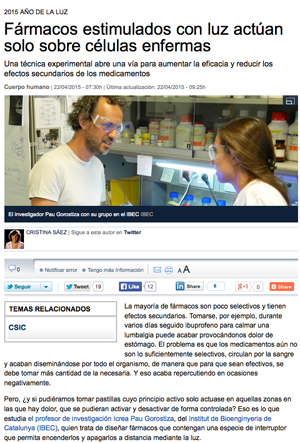
Researchers in Barcelona discover more potential candidates on the route to tailored, photo-switchable therapies by disproving design limitationLast year, scientists at the Institute for Bioengineering of Catalonia (IBEC), IRB Barcelona and the UB announced that they had achieved photo-switchable, or light-regulated, molecules to control protein-protein interactions – key determinants in biological processes, and therefore highly promising therapeutic targets – in a remote and non-invasive way.
A group at IBEC has identified a important factor in E. coli infection, opening the way to developing targeted drugs against the potentially deadly condition.Most E. coli bacterial strains occur naturally in the human gut and pose no harm to health, except for the one particular serotype that always hits the news, O157:H7, which can cause food poisoning and can become life-threatening in certain patients.