“The Use of Nanoparticles for the Regeneration of Bone Fractures and Osteoporosis”
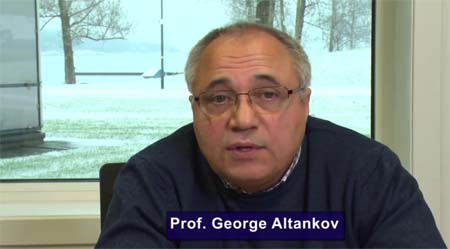
 Elisabeth Engel and George Altanvkov appear in the latest video produced by the Israeli partner of EuroNanoMed, the Chief Scientist Office of the country’s Ministry of Health (CSO-MOH), “Success stories funded by EurNanoMed2”.
 IBEC is a key player in a new network of organizations working together to exploit Big Data from life and food sciences
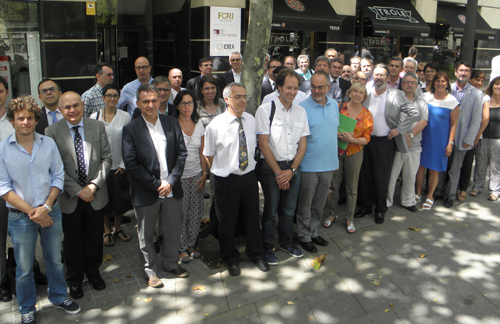
Monday saw the launch of the Associació Bioinformatics Barcelona (BIB), a network of 25 members including universities, research centres, hospitals, major scientific facilities, and pharmaceutical, technology and and bioinformatics companies, which aims to respond to the challenges posed by the growth of big data and position Barcelona as a world leader in bioinformatics.
In compliance with Law 19/2014 (Transparency, public access to information and good governance), this section provides all the information about IBEC we are obliged to provide in order to adhere to the principles of the law. En compliment de la Llei 19/2014 de transparència, accés a la informació pública i bon govern, en aquest apartat … Read more
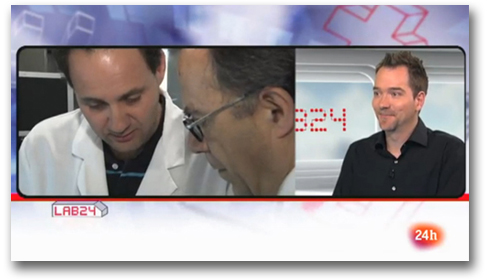 On 30 June the rtve science programme Lab24 featured an interview with new IBEC group leader Samuel Sánchez, who describes his research on micro and nanomotors.
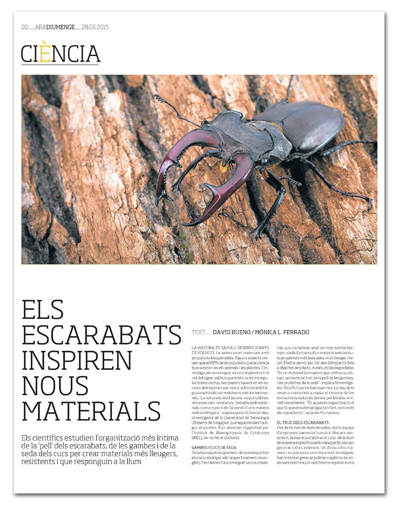 IBEC alumnus Javier G. Fernandez, who was visiting to give a seminar last week, was featured in an article about new materials inspired by insects in Catalan magazine ARA this weekend.
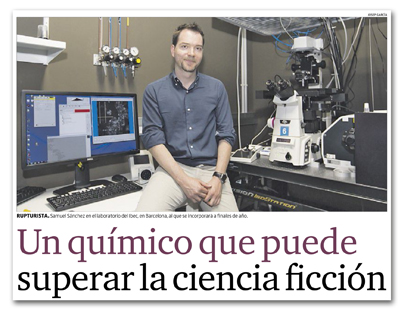 IBEC group leader Samuel Sánchez was the subject of an article in El Periódico on Tuesday.
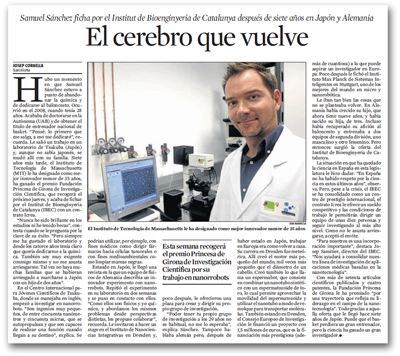 An article about new IBEC group leader Samuel Sanchez by Josep Corbella in La Vanguardia yesterday talks about the ‘brain gain’ of having the nanotechnologist return to Catalonia after several years in Japan, the USA and Germany.
 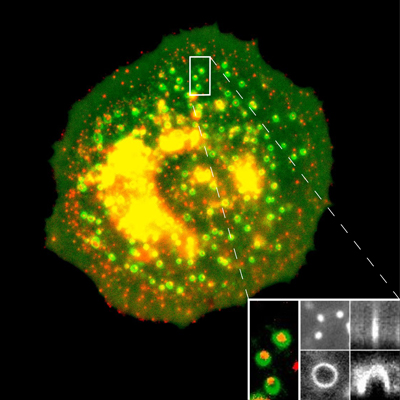 A study by the Institute for Bioengineering of Catalonia (IBEC) reveals how cells withstand breakage during the constant changes in shape and volume experienced in most biological processes
During critical biological processes such as embryonic development, breathing, the pumping of the heart, wound healing and tumor growth, the body’s cells are stretched and distorted to adapt to their environment. The cell’s membrane, though, is rigid and inflexible. So how does it withstand all these constant deformations, so that it doesn’t break?
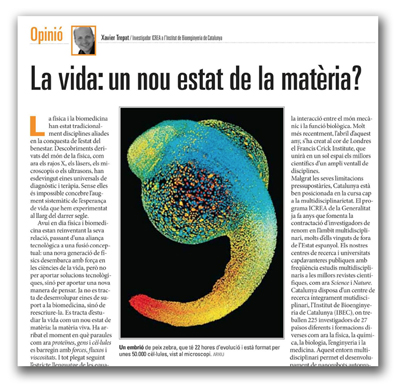 An opinion piece by Xavier Trepat appears in the current edition of El Punt Avui.
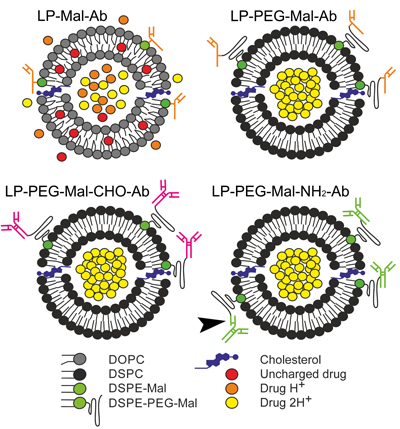 IBEC and ISGlobal’s joint unit, Nanomalaria, has published a new therapeutic strategy against malaria.
The study, which appeared in the current edition of the Journal of Controlled Release, tackles a major hurdle in malaria treatments, which is that most antimalarial drugs start working on the infected cell quite late in Plasmodium’s life cycle, when their effect is often too short to be lethal to the parasite. The work has been done in collaboration with GlaxoSmithKline, as one of the few cases of partnerships involving industry in the research and development of innovative antimalarial nanomedicines.