- A new study led by the Institute for Bioengineering of Catalonia (IBEC) shows that a single biomaterial can be locally “programmed” to be rigid in some areas and flexible in others, mimicking a strategy long used by insects and other arthropods.
- As a proof of concept, described in the Journal of Materials Chemistry A, the researchers built articulated structures combining rigid segments and flexible joints to enable controlled movement within a single continuous sheet.
- Inspired by how nature builds complex structures from a single material, the approach could simplify both manufacturing and recycling. Locally tuning one biodegradable material with trace amounts of metals avoids producing different materials for different functions and could allow the whole object to be recycled or composted together, eliminating the sorting and separate recovery that multi-material products require.
Researchers from the Biointegrated Materials and Engineering group at the Institute for Bioengineering of Catalonia (IBEC) have shown that adding trace amounts of different metal ions to chitosan can locally tune how stiff, strong or flexible the material becomes, without changing its underlying chemistry. Chitosan is a biopolymer derived from chitin, commonly sourced from crustacean shells but also obtainable from fungi, insects and other renewable waste. The approach, published recently in the Journal of Materials Chemistry A, borrows a strategy long used by nature — such as the flexible joints and rigid plates that make up a single insect exoskeleton — to explore how a single sustainable material could do the mechanical work of several.
Programming one material, several ways
Modern products are usually built by combining several different materials, each chosen for a specific job — think of a bottle and its cap, or a rigid casing around a flexible seal. That strategy meets short-term performance needs, but it comes at a cost at the end of a product’s life.
If a single material can be tuned to behave very differently from one region to another, it can still be recycled or composted as one material, with no sorting needed first.
Javier G. Fernández
“Today, the main bottleneck in recycling isn’t the material itself — it’s recovering and sorting the different materials that make up a single object,” says Javier G. Fernández, ICREA Research Professor at IBEC and leader of the study. “If a single material can be tuned to behave very differently from one region to another, it can still be recycled or composted as one material, with no sorting needed first.” Plastics alone come in hundreds of different types, each requiring its own recycling stream.
In contrast with this multimaterial approach, living organisms achieve different mechanical functions within a single structure by locally tuning a limited set of building blocks. Insects, for example, build their exoskeletons around chitin — the natural polymer from which chitosan is derived — adapting different regions for support, movement, or protection. This economy of materials reflects an evolutionary strategy known as the “survival of the cheapest”: achieving broad functional diversity without multiplying the materials needed. “Nature routinely changes the local properties of a single material to gain efficiency,” Fernández explains. “An insect builds its whole exoskeleton as one continuous piece, yet it includes parts that are very flexible, like the joints in its legs, and parts that are very rigid, like the thorax or the wings. That’s efficient to produce, because the animal only has to fine-tune a single process, and it’s mechanically efficient too, because a seamless structure is far stronger than one built by joining separate pieces.”
To put this principle into practice, the IBEC team used chitosan, a derivative of chitin, to capture metal ions within the structure of thin films. They introduced copper, zinc, or nickel ions while the polymer was dissolved, trapping them within the material as it dried. An alkaline treatment then made chitosan’s natural binding sites more available to engage with the embedded ions. These interactions reshape how the polymer chains associate, giving researchers a way to tune the material’s mechanical behavior by choosing the metal while preserving its underlying chemical backbone.
We wanted to show, in a single object, that you can fold and unfold it in a controlled way — like an insect wing — without any glue, seams or separate parts.
Akshayakumar Kompa
The result is the same base polymer with markedly different mechanical personalities depending on which metal was added. Under dry conditions, zinc-doped chitosan became more than 50% stronger and stiffer than plain chitosan, though less stretchy; copper-doped chitosan became more compliant, stretching much further before breaking, at the cost of strength; nickel-doped chitosan fell in between. The most distinctive result appeared once the films were wetted: while plain chitosan and the copper- and zinc-doped versions weakened in water, as most biological and biology-inspired materials do, the nickel-doped version became stronger and stiffer instead — a reversal the team had already observed, and studied in more mechanistic depth, in a related chitosan-nickel material described in an earlier IBEC study published in Nature Communications.
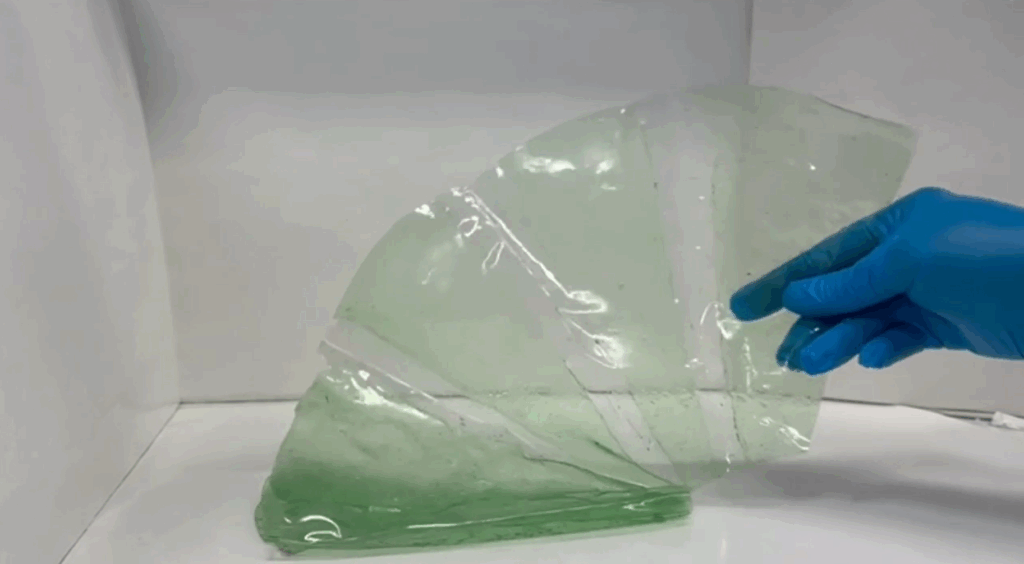
To demonstrate how useful this local “programming” can be, the team built a fan-shaped, origami-inspired structure that combines a stiff, nickel-doped chitosan with a flexible, plain chitosan in a single continuous sheet. “We wanted to show, in a single object, that you can fold and unfold it in a controlled way — like an insect wing — without any glue, seams or separate parts,” says Akshayakumar Kompa, a postdoctoral researcher in Fernández’s group at IBEC and the study’s first author.
The team also tested how the different versions of the material broke down in soil. Over three weeks, the zinc-doped films degraded completely, the copper-doped films lost about half their mass, and the nickel-doped films — the toughest of the three when wet — degraded the slowest, losing about a quarter of their mass over the same period.
Next steps
These early results open a promising route to using biological materials as nature does: creating diverse mechanical functions by tuning local properties within a continuous structure. Beyond the films demonstrated here, the advance offers a design principle for sustainable, biointegrated objects that combine support and movement in a single material. The next steps are to assess durability under repeated movement, adapt the process for larger-scale manufacturing, and establish how the materials break down and interact with the environment. Soil tests already show metal-dependent differences in mass loss; further studies will distinguish biological degradation from dissolution and fragmentation, quantify metal release, and assess environmental safety. Together, these efforts will help translate the concept into practical designs.
Referenced paper
Akshayakumar Kompa and Javier G. Fernández. Artificial reproduction of chitinous mechanical versatility through metal doping and its use in resource-efficient product design. Journal of Materials Chemistry A (2026). DOI: 10.1039/D6TA04260K