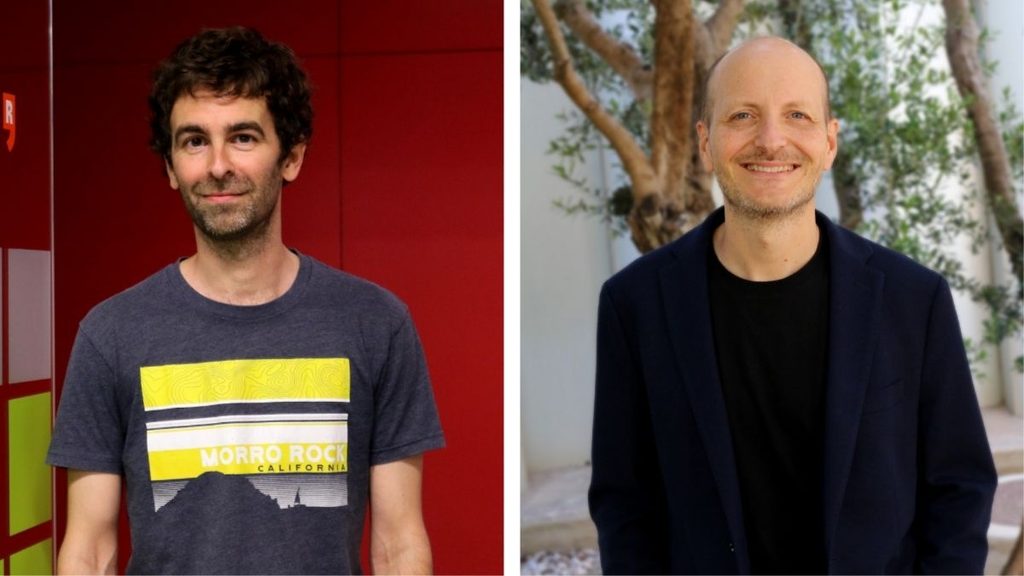
The Fundació La Marató de 3Cat has selected two projects coordinated by IBEC researchers Xavier Rovira and Xavier Trepat in its 2025 call for cancer research grants. Each project will receive €300,000. Over three years, both will study why immune cells struggle to penetrate solid tumours, one of the main obstacles facing immunotherapy in cancers such as breast and colorectal cancer.
La Marató de 3Cat 2025, held on 14 December, was dedicated to cancer and raised a final total of €14,425,548. Today, at an event held in TV3’s Studio 1, the Foundation presented the 38 projects selected to receive this funding. A total of 201 proposals were submitted and assessed by 169 international experts through a peer-review process managed by the Agency for Health Quality and Assessment of Catalonia (AQuAS). Two of the selected projects are coordinated by IBEC.
Engineered NK cells to break through breast cancer’s defences
The iNKFILTRATE project is coordinated by Xavier Rovira Clavé, leader of IBEC’s Spatial Biotechnology group, and is carried out jointly with the iPSC-Derived Advanced Therapies group led by Belén Álvarez Palomo at the Banc de Sang i Teixits (BST). The project focuses on natural killer (NK) cells, a type of immune cell that can recognise and eliminate tumour cells.
The team will obtain these cells from induced pluripotent stem cells (iPSCs). This standardised source could, in the future, make it possible to produce them on a large scale and have them available for any patient. Current CAR-T therapies, by contrast, are manufactured individually from each person’s own cells.
To help them find their target, the researchers will genetically modify these cells so that they recognise p95HER2, a variant of the HER2 protein found in a proportion of HER2-positive breast cancers and absent from healthy tissue. They will also equip the cells with tools to make their way through the stroma, the dense layer of tissue that shields the tumour. In addition, they will prepare them to remain active in an environment that tends to switch off the body’s defences.
The researchers will test these variants in three-dimensional in vitro models of breast cancer and in animal models. To analyse them, they will use high-resolution spatial imaging techniques such as multiplexed ion beam imaging (MIBI), which make it possible to map, cell by cell, where the NK cells are located within the tumour. This will allow them to identify which features of tumour organisation are associated with an effective response. The aim is to find potential predictive biomarkers and establish design criteria for future cell-based immunotherapies against solid tumours.
Tumour mechanics as a barrier to immune cells
The second project is coordinated by Xavier Trepat, leader of IBEC’s Integrative Cell and Tissue Dynamics group, in collaboration with the group led by Luis Francisco Lorenzo-Martín at the Cancer Research Centre (CIC) in Salamanca. Until now, research into how colorectal tumours manage to escape the immune system has focused mainly on biochemical and genetic factors. This project starts from a different hypothesis: that the mechanical properties of the tumour and the forces generated within it make it harder for T lymphocytes to get in and eliminate cancer cells.
To test this, the teams will develop ‘mini-colons’, a type of organ-on-a-chip system. These systems combine tumour organoids, some of them patient-derived, with cancer-associated fibroblasts, endothelial cells and immune cells, arranged to reproduce the architecture of the tissue.
The researchers will measure the stiffness and cellular forces in this environment and modify them using tools such as optogenetics or drugs. This will allow them to study how the tumour’s physical environment affects the migration and cytotoxic capacity of T cells. The results could help identify physical mechanisms that prevent immune cells from entering the tumour and that could be targeted to make immunotherapy more effective, as well as provide new tools to evaluate it.
Both projects focus on basic and preclinical research, a key stage for generating the knowledge and tools needed to make new immunotherapy strategies for solid tumours possible in the future. IBEC thanks the Fundació La Marató de 3Cat and everyone who contributed for their support, which makes possible research driven by citizens’ commitment to the fight against cancer.