
Scientists from the Institute for Bioengineering of Catalonia (IBEC) and King’s College London have discovered that cells do not just sense mechanical forces but also measure how long those forces last before responding. The findings, published in Nature Materials, reveal a timing mechanism that allows cells to ignore brief mechanical noise while reacting to sustained changes, a process that is crucial in diseases such as cancer and fibrosis.
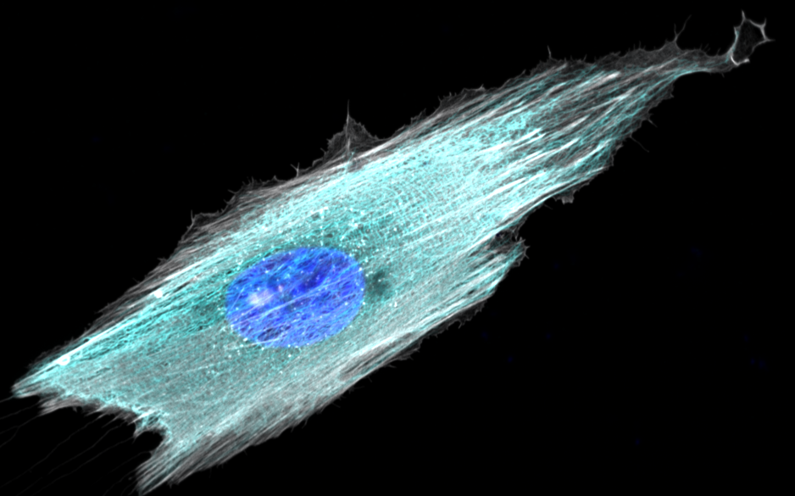
Scientists have discovered how cells decide when to respond to physical forces, potentially opening new avenues for tackling diseases such as cancer and fibrosis.
The study, led by researchers at the Institute for Bioengineering of Catalonia (IBEC) and King’s College London, reveals that cells in the body don’t just sense forces, they also measure how long those forces last before deciding to act.
In so doing, they outline a timing mechanism that allows cells to ignore brief mechanical stimuli while reacting to sustained changes, a process that is crucial in the progression of disease.
In everyday life, cells are exposed to a wide range of mechanical signals. Tissues in organs such as the lungs, heart or bladder constantly experience fast, repetitive forces from breathing, heartbeats or bladder emptying, while slower and more persistent changes occur during processes such as wound healing or tumour growth.
Cells must continuously interpret these physical forces alongside chemical signals from their surroundings. While scientists have long understood how cells respond to chemical cues, much less was known about how they process mechanical signals over time.
Understanding how cells interpret how these complex mechanical signals are playing a part in disease progression could empower researchers design better therapies in the future.
Amy Beedle
Now, researchers believe that cells use a ‘low-pass filter’ to screen short-term disturbances, but respond to persistent, longer-term changes.
Professor Pere Roca-Cusachs, senior author of the work, principal investigator of the the Cellular and Molecular Mechanobiology group at IBEC and Full Professor at the Faculty of Medicine and Health Sciences of the University of Barcelona (UB), explains:
“Imagine you’re driving on a motorway and hear a loud noise next to you. Likely, you’ll react immediately because it could be dangerous. But if you hear a small, unusual sound from your own engine, you might ignore it unless it persists for some time. Cells face a similar challenge – they need to decide which signals matter, and when to respond to them.”
The team found that cells rely on structures called fibrillar adhesions, specialised contact points that allow cells to physically grip their surroundings and transmit mechanical forces to their interior, for this mechanism.
These structures help ‘hold’ the cell’s nucleus in a deformed state even after the force disappears, allowing the signal to persist for about an hour – held together by a network of fibres called vimentin to maintain the effect over time. When this system is disrupted, cells lose the ability to “hold onto” mechanical signals and respond much more quickly – but less selectively.
In effect, this creates a biological filter. Brief forces are ignored, but sustained ones trigger a response. Many important processes, including the activity of cancer-linked protein YAP, depend on this timing.
Dr Amy Beedle, Lecturer in Biological Physics at King’s and lead author of the study, said “This work has huge implications for not just how cells and tissues function, but this temporal element, which we’re amongst the first to examine, is big for the future of treatment.
“Many diseases, including cancer and fibrosis, involve long-term changes in tissue stiffness and mechanical forces. Understanding how cells interpret how these complex mechanical signals are playing a part in disease progression could empower researchers design better therapies in the future.”
The findings also show that this mechanism helps protect the cell’s nucleus from damage under physical stress.
The team now aims to further explore how this timing mechanism works in complex tissues and disease settings, where mechanical changes are a key part of disease progression.
The study also involved the collaboration of the IBEC’s Integrative Cell and Tissue Dynamics group, led by ICREA Research Professor Xavier Trepat.
Referenced paper
Amy E. M. Beedle, Vivek Sharma, Jorge Oliver-De La Cruz, Anuja Jaganathan, Aina Albajar-Sigalés 1, F. Max Yavitt, Kaustav Bera, Ion Andreu, Ignasi Granero-Moya, Dobryna Zalvidea, Zanetta Kechagia, Gerhard Wiche, Xavier Trepat, Johanna Ivaska, Kristi S. Anseth, Vivek B. Shenoy & Pere Roca-Cusachs. Fibrillar adhesion dynamics govern the timescales of nuclear mechano-response via the vimentin cytoskeleton. Nature Materials (2026). DOI: https://doi.org/10.1038/s41563-026-02590-x