DONATE

Registration open for Bojos per la Ciència 2018
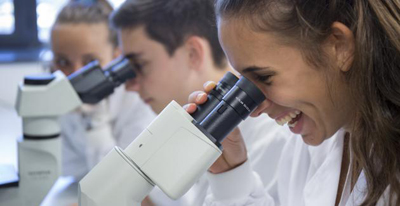
Registration for high school students is open until 23rd October for “Bojos per la Ciència” (Crazy about Science), the Fundació Catalunya-La Pedrera initiative that aims to encourage scientific vocation.

2018 will be the first year that IBEC takes part in the programme, first launched in 2013, which offers courses – held on a series of Saturdays throughout the year – to selected high school students who show aptitude in science.

The theoretical-practical sessions taught by researchers at the participating research centers, which include IRB, CREI, ICN2, ICIQ and more, cover topics such as biochemistry, biomedicine, economics, physics, food, mathematics, nature, new technologies and chemistry.

PhD position in Nanoscale bioelectrical characterization


Application Deadline: 18/10/2017 17:00H
Ref: PD-GG

The Nanoscale Biolectrical Characteritzation group at the Institute for Bioengineering of Catalonia (IBEC) and the Nanostructure of Biomembranes group from the University of Barcelona (UB) is looking for a PhD position funded through the call “Ayudas para contratos predoctorales para la formación de doctores 2017″ (Ref. TEC2016-79156-P), from the Spanish Ministry of Economy and Competitivity (MINECO).

An effective strategy for the targeted delivery of new antimalarials

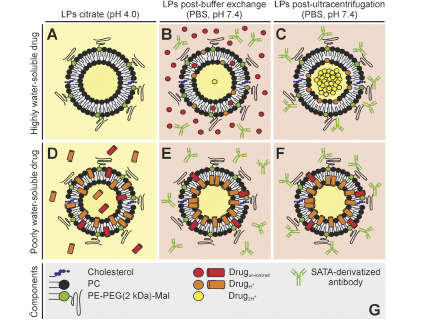
Xavier Fernàndez Busquets’ joint IBEC-ISGlobal Nanomalaria group has moved a step closer to the validation of immunoliposomes as a vehicle for antimalarial drugs by showing that they increase the efficacy of lipohilic (poorly soluble) compounds in a mouse model of malaria.

The results, published in Biomaterials, suggest that this strategy could be used for the treatment of severe malaria.

Most antimalarial drugs currently in the pipeline are poorly soluble in water, and high amounts are needed to ensure their efficacy, particularly in cases of severe malaria.

Presenting IBEC’s 3D bioprinting capabilities at the second IN(3D)USTRY event

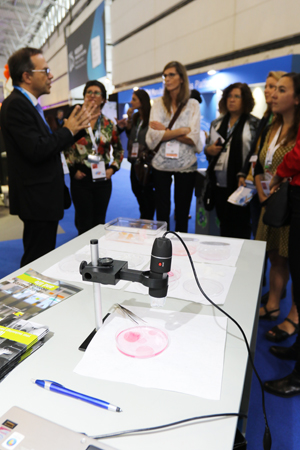
This week IBEC is attending the second edition of “IN(3D)USTRY: From Needs to Solutions”, the international meeting devoted to 3D printing.

The institute has a stand in the exhibition area, where Head of Technology Transfer Xavier Rubies, Technology Transfer manager Xavier Puñet and Nanotechnology Platform Coordinator Mateu Pla are welcoming visitors interested in finding out more about IBEC’s 3D bioprinting capabilities.

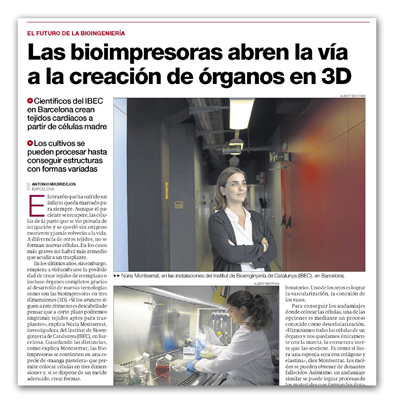
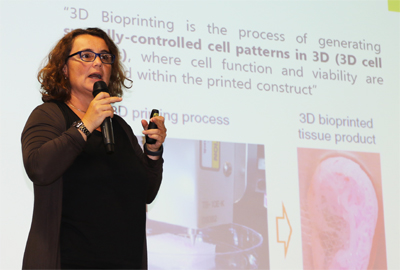
Yesterday lunchtime IBEC director Josep Samitier gave a talk about the challenges and possibilities of 3D bioprinting, where he outlined some of IBEC’s relevant projects including the cardiac regeneration research by Nuria Montserrat’s group and the bioreactors being developed by Elena Martinez.

IBEC at active ageing festival in the UK

Yesterday and today IBEC has been exhibiting at the Coventry Life Festival in the UK, a celebration of active ageing which is taking place in the university town not far from Birmingham.
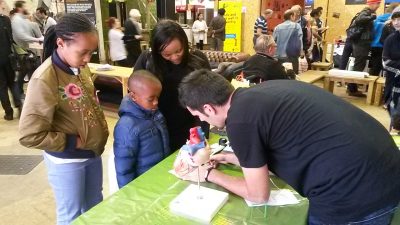
Sunday saw more than 1000 middle-aged and elderly residents and their families flock to the city for the Vitality Marketplace, a showcase of resources and information about healthy and active ageing.

Supported by EIT health, IBEC’s stand is demonstrating the 3D bioprinting techniques being optimised in the institute to tackle age-related disease by creating biomaterials to aid the regeneration of organs such as the heart, as well as giving out information about the institute to potential masters and PhD students.

Samuel breaks own record for smallest jet engine

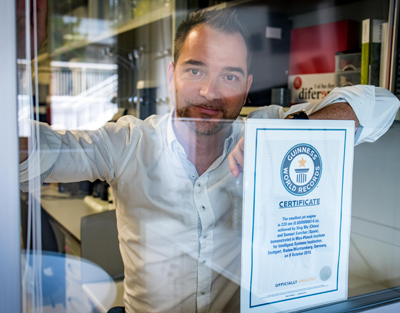
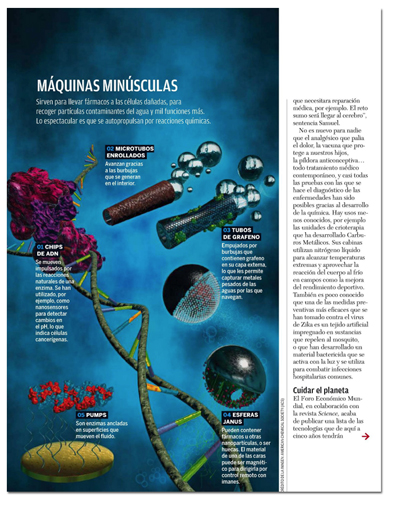
Samuel Sanchez has broken his own Guinness World Record for the smallest jet engine.

The ultimate authority in record-breaking achievements has recognized his and Xing Ma’s nanotube, 220nm or 0.00022 millimeters in size, as the world’s tiniest jet engine. Previously, Samuel and his collaborators from IFW Dresden held the record until this year, with a 600nm tube.

The tubular ‘engine’ is powered by an enzyme-triggered biocatalytic reaction using urea as fuel. The reaction creates an internal flow that extends out into the surrounding fluid through one of the cavities, causing a flux of fluid that results in thrust, propelling the nanotube along.

3D bioprinting and its practical applications in health

The Spanish Platform for Nanomedicine (NANOMED Spain), the Spanish Platform for Innovation in Healthcare Technology and the HealthTech Cluster came together today for a conference on 3D printing and its applications in the health sector in Barcelona.

Clinical researchers from all over Spain, hospitals, health authorities and representatives of pharmaceutical, biotechnology and health technology companies, among others, met to discuss the use of 3D bioprinting – 3D printing with cells – whose potential in the field of health, and particularly in tissue and organ regeneration, is huge. During the event’s three round table discussions, they talked about the current situation, future prospects and challenges presented by this new technology.