“El control del món nanomètric”

Group leader
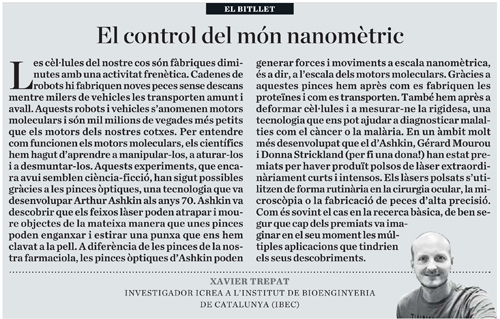
 IBEC group leader Xavier Trepat penned a short article for ARA magazine in which he discusses the research of Arthur Ashkin, Gérard Mourou and Donna Strickland, winners of the the Nobel Prize for Physics.
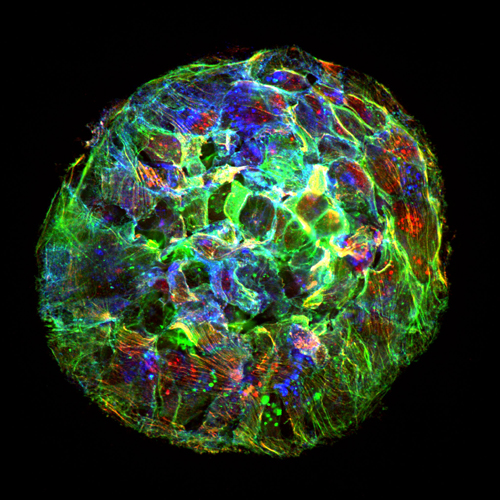
 Researchers from IBEC and UB have discovered that the way tumor cells expand defies the laws of physics.
In an article published today in Nature Physics, the researchers have challenged our current understanding of the discipline and developed a new framework that could help predict the conditions under which tumors initiate metastasis.
 A review by IBEC group leader and ICREA research professor Xavier Trepat is one of six featured in Nature Physics’ latest ‘Insight’ issue, ‘The Physics of Living Systems’, in which all the articles have been co-authored by a physicist and a biologist.
Penned together with collaborator Erik Sahai from London’s Francis Crick Institute, Xavier’s article, ‘Mesoscale physical principles of collective cell organization’, reviews recent evidence showing that cell and tissue dynamics are governed by mesoscale physical principles – force, density, shape, adhesion and self-propulsion.
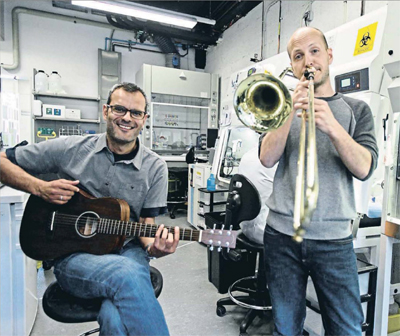
 In a La Vanguardia feature by Josep Corbella, IBEC’s Xavier Trepat is interviewed along with IRB’s Salvador Aznar-Benitah about the important role music plays in their lives, how it has affected their careers as researchers, and about the relation and similarities between musical and scientific creativity.
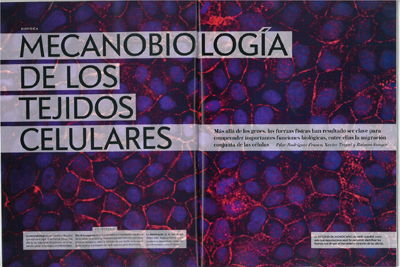
 An article by IBEC researchers Pilar Rodríguez, Xavier Trepat and Raimon Sunyer about the importance of physical forces in understanding biological function appears in the June edition of Investigación y Ciencia, the Spanish-language version of Scientific American magazine.
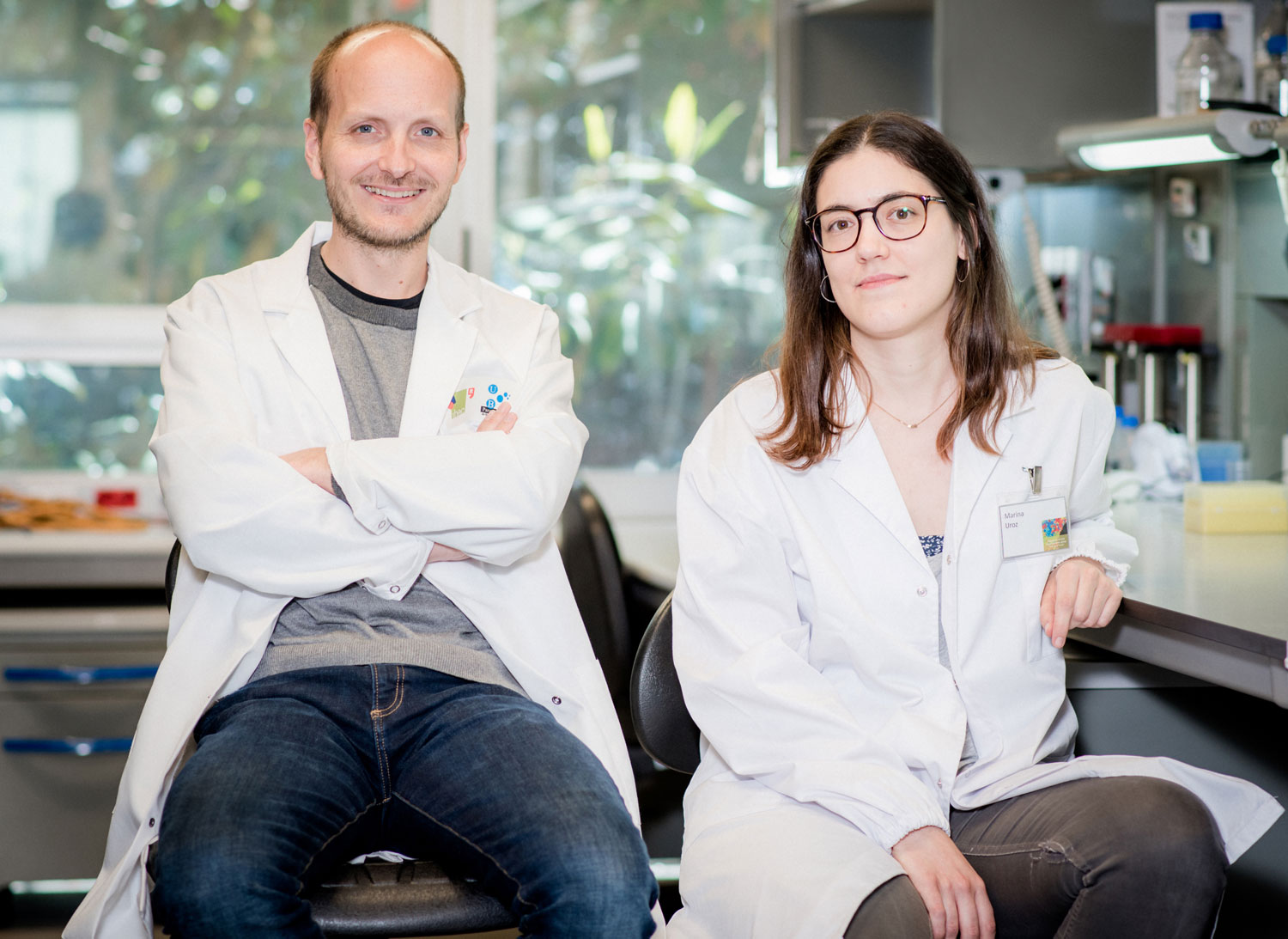
 Researchers at IBEC have discovered that cell division in epithelial tissues is regulated by mechanical forces.
This revelation could potentially open avenues to a greater understanding of the uncontrolled proliferation of cancer cells in tumors, and their possible regulation by means of physical forces.
Publishing in the June edition of Nature Cell Biology, the research group of ICREA professor Xavier Trepat, group leader at IBEC and associate professor at the University of Barcelona (UB), describe how the mechanical state of epithelial tissues – the continuous sheets of cells that cover all the exposed surfaces of the body – is related to the cell cycle and cell division.
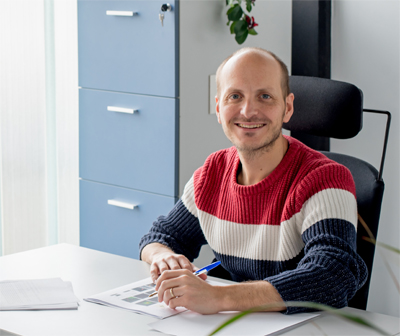
 IBEC group leader and ICREA research professor Xavier Trepat has been elected as a Member of EMBO, the European Molecular Biology Organisation.
EMBO’s members are 1,800 leading researchers that promotes excellence in the life sciences, and new ones are elected annually in recognition of their contributions to scientific excellence. Of the 62 researchers from 24 countries to receive membership this year, Xavier is one of the only two researchers in Spain.
The Integrative Cell and Tissue Dynamics group leader is IBEC’s first full EMBO Member, and one of just 79 based in Spain. In 2016 IBEC group leader Pere Roca-Cusachs was accepted into the EMBO Young Investigator Programme.
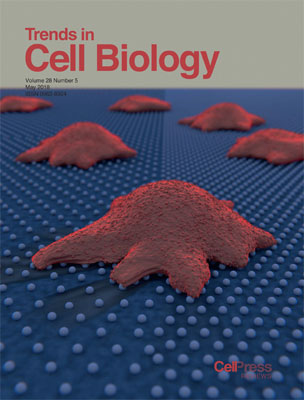
 Alberto Elosegui-Artola, Xavier Trepat and Pere Roca-Cusachs’ paper in Trends in Cell Biology has made the cover of the latest issue of the Cell-family journal.
In ‘Control of Mechanotransduction by Molecular Clutch Dynamics’, the IBEC researchers review how cell dynamics and mechanotransduction are driven by molecular clutch dynamics.
The molecular clutch hypothesis suggests a mechanism of coupling between integrins and actin during cell migration, whereby a series of bonds that dynamically engage and disengage link cells to their microenvironment.
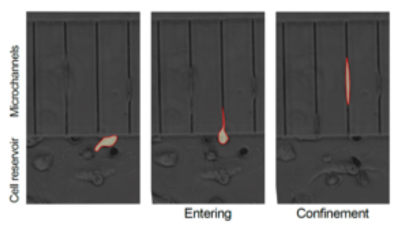 Researchers have shown for the first time that ion channels that are capable of detecting changes in the physical properties of the cellular environment play a key role in tumor invasion and metastasis.
The discovery, led by led by Miguel Angel Valverde from the Department of Experimental and Health Sciences of the UPF and involving IBEC’s Integrative Cell and Tissue Dynamics group, could open new avenues in the development of new drugs that reduce the risk of metastasis.
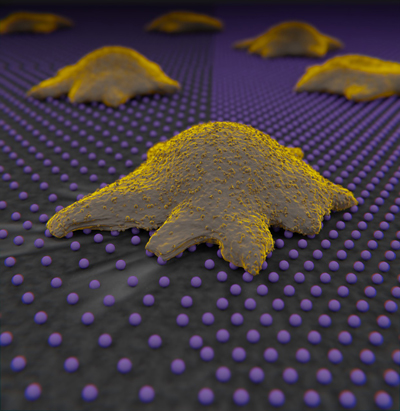 The way cells find their way around is by ‘groping’ rather than seeing their surroundings: this is the main conclusion of a study published in Nature last week involving several IBEC groups and their collaborators.
“We determined how cells detect the position of molecules (or ligands) in their environment with nanometric accuracy,” explains Pere Roca-Cusachs, group leader at IBEC and assistant professor at the University of Barcelona, who led the study. “By adhering to the ligands, the cells apply a force they can detect. As this force depends on the spatial distribution of the ligands, this allows the cells to ‘feel’ their surroundings. It’s like recognizing somebody’s face in the dark by touching it with your hand, rather than seeing the person.”