EUCYS 2016: Miquel Bosch
 Àngels López
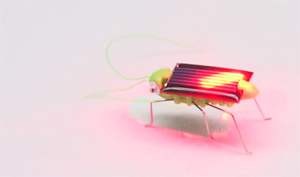
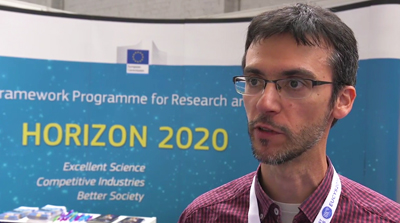 A video of an interview of Miquel Bosch, a Marie Skłodowska-Curie fellow in the Nanoprobes and Nanoswitches group, talking about his research on drugs activated by light and demonstrating with a home-made cockroach armed with a light sensor.
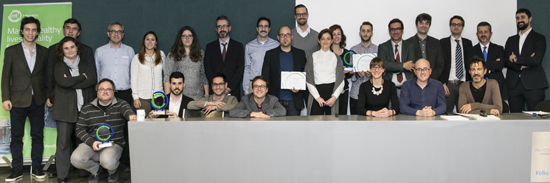 IBEC group leaders Eduard Torrents and Elisabeth Engel both received awards at last week’s EIT Health Spain event at the PCB.
Eduard’s project, Novel Antimicrobial Therapy, won first prize in the ‘PoC +’ category of EIT health Spain’s Proof of Concept (PoC +) awards, and in the ‘PoC’ category, Elisabeth won a prize for Dermoglass, the smart dressing for the treatment of chronic wounds.

Application Deadline: 15/01/2017
Ref: JS-LA
The Nanobioengineering and Nanoscopy for Nanomedicine groups at the Institute for Bioengineering of Catalonia (IBEC) is looking for a Postdoctoral Researcher to develop the project EuroNanoMed-2.
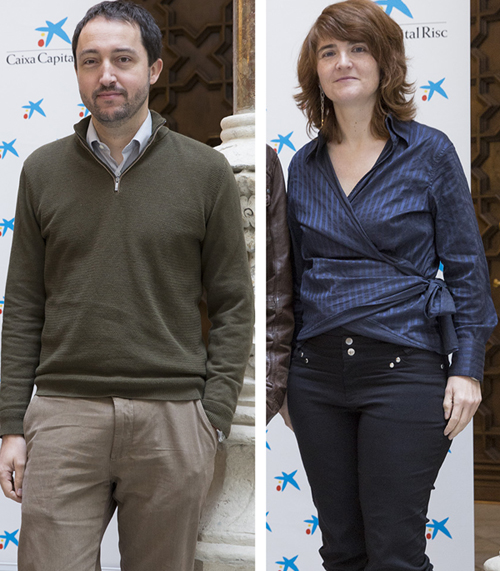 Two IBEC projects have been granted funding as part of the 2016 CaixaImpulse programme, which is organized by the ”la Caixa” Foundation and Caixa Capital Risc.
Cellular and molecular mechanobiology group leader Pere Roca-Cusachs’ project, “Solid tumor therapy”, and “ISCHEMSURG”, led by Monica Mir, senior researcher in Josep Samiiter’s Nanobioengineering group, will each receive up to €70,000 through this year’s programme, which aims to promote technology transfer in science.


Application Deadline: 28/02/2017
Ref: MC-GG1
The Nanoscale Biolectrical Characteritzation group at the Institute for Bioengineering of Catalonia (IBEC) is looking for a Early Stage Researcher (PhD student) to develop his PhD thesis project on the development of a novel Nano-tomographic technique based on electrostatic force microscopy. The contract will be within the framework of the SPM2.0 Marie Skłodowska-Curie European Training Network (MSCA-ITN-2016-721874), whose objective is to train a new generation of early stage researchers in the most advanced Scanning Probe Microscopy techniques.
Application Deadline: 28/02/2017
Ref: MC-GG2
The Nanoscale Biolectrical Characteritzation group at the Institute for Bioengineering of Catalonia (IBEC) is looking for a Early Stage Researcher (PhD student) to develop his PhD thesis project on the label-free mapping of biological membranes’ composition with nanoscale spatial resolution. The contract will be within the framework of the SPM2.0 Marie Skłodowska-Curie European Training Network (MSCA-ITN-2016-721874), whose objective is to train a new generation of early stage researchers in the most advanced Scanning Probe Microscopy techniques.
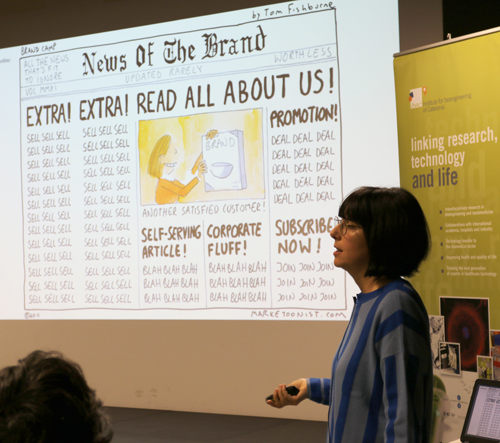 Last week more than 50 people attended a special event organised by IBEC, “Advancing Gender Equality and Diversity in Science”. The morning of talks and discussions aimed to raise awareness and reflect on how to balance gender equality, and particularly how institutions, as well as society in general, can address such issues via best practices or other strategies.
The proceedings began with a look at gender and aging stereotypes in society and specifically in science and advertising by marketing and communications consultant Montse Montllau, followed by an examination by CRG Group Leader Dr. Mara Dierssen of more science-based issues such as bias in publishing papers, raising funds and recruitment procedures.
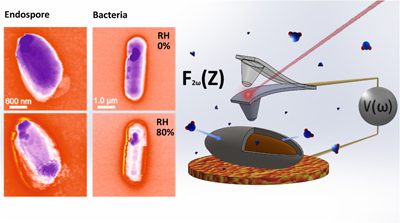 An IBEC group has demonstrated, for the first time, that the hydration properties of a single bacterial endospore in varying environmental relative humidity can be determined with high accuracy and reproducibility, and in a non-destructive way, shedding new light on endospore survival strategies.
Endospores are recognized as the hardiest form of life on Earth, and are produced by certain bacterial cells in response to a lack of nutrients.
 IBEC has become a partner in the Red de Innovación en Tecnologías Médicas y Sanitarias (ITEMAS), an innovation network for medical and health technologies.
ITEMAS, promoted by the Instituto de Salud Carlos III (ISCIII), brings 95 companies and organizations together with 66 medical centres in Spain to collaborate on R+D projects. The partners will also work together on outreach initiatives.