Mechanobiology of cancer summer school 2019
The MECHANO·CONTROL consortium, led by several research institutions across Europe, is launching a Summer School that will be taking place between 17-20 of September 2019 at the Eco Resort in … Read more
The MECHANO·CONTROL consortium, led by several research institutions across Europe, is launching a Summer School that will be taking place between 17-20 of September 2019 at the Eco Resort in … Read more
The MECHANO·CONTROL consortium, led by several research institutions across Europe, is launching a Summer School that will be taking place between 17-20 of September 2019 at the Eco Resort in … Read more
The IBEC annual symposium brings together high-profile international experts for an open forum for interdisciplinary discussions and networking. This year the symposium is dedicated to Bioengineering for Active Ageing, … Read more
The IBEC annual symposium brings together high-profile international experts for an open forum for interdisciplinary discussions and networking. This year the symposium is dedicated to Bioengineering for Active Ageing, … Read more
The IBEC annual symposium brings together high-profile international experts for an open forum for interdisciplinary discussions and networking. This year the symposium is dedicated to Bioengineering for Active Ageing, … Read more
The IBEC annual symposium brings together high-profile international experts for an open forum for interdisciplinary discussions and networking. This year the symposium is dedicated to Bioengineering for Active Ageing, … Read more

Application Deadline: 20/06/2019
Ref: TEC-EE
The Biomaterials for regenerative therapies group at the Institute for Bioengineering of Catalonia (IBEC) is searching for a Technician position to work in in vivo models for biomaterial development. Research in the Biomaterials for Regenerative Therapies group is devoted to the development and knowledge transfer to industry and innovative biomaterials and scaffolds for tissue regeneration.
Después de una lesión aguda, como un infarto de miocardio, el corazón humano es incapaz de regenerarse. Las células cardíacas adultas no pueden crecer y dividirse para sustituir a las dañadas, y la lesión se vuelve irreversible. Pero esto no pasa en todos los animales. Un pez de agua dulce originario del Sudeste Asiático, conocido como pez cebra, puede regenerar su corazón por completo incluso después de la amputación del 20% de su ventrículo.
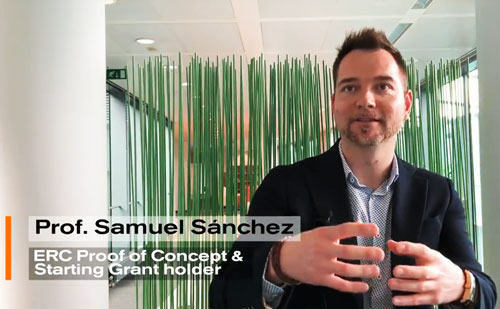
 Samuel Sánchez, investigador principal en el Instituto de Bioingeniería de Catalunya (IBEC), presentó el pasado 3 de mayo en Bruselas la nueva generación de NanoBots y BioBots desarrollados en su grupo de investigación.
 La presentación se hizo durante los Seminarios del Consejo Europeo de Investigación (ERC). El público asistente a la charla estaba compuesto por personal científico de la ERC, además de una audiencia general de la Comisión Europea.
Bajo el título “De Nanobots hacia BioBots 3D como futuras herramientas en robótica y medicina” el profesor Samuel Sánchez presentó en su seminario, los aspectos fundamentales de las nanopartículas propulsadas por catálisis, -también llamadas nanobots- para sus aplicaciones en la remediación ambiental y también en el futuro de la nanomedicina inteligente.