“Envelliment humà, on estan els límits?”
Part of the CCCB’s “+Humans: el futur de la nostra espècie” exhibition
Part of the CCCB’s “+Humans: el futur de la nostra espècie” exhibition
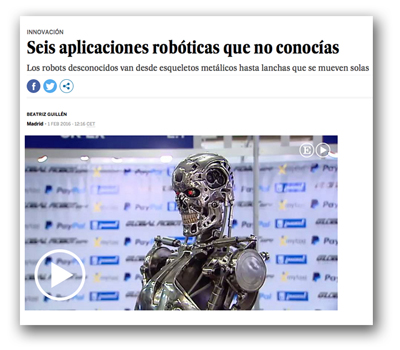
 Los nanorobots de Samuel Sánchez son una de las “Seis aplicaciones robóticas que no conocías” que se describen en un artículo de El Pais .
 Este artículo cubre la reciente Expo Robot Global en Madrid, en la que Samuel era uno de los ponentes y explica las diversas aplicaciones para la investigación actual en robótica, incluyendo los robots para la terapia y la rehabilitación, el reciclaje, la búsqueda y el rescate, las ciudades inteligentes, la agricultura y, por supuesto, la medicina.

Application Deadline: 15/02/2016
Ref: PD-PG
The Nanoprobes and Nanoswitches group at the Institute for Bioengineering of Catalonia (IBEC) is looking for predoctoral candidate to participate in the development of light regulated drugs.
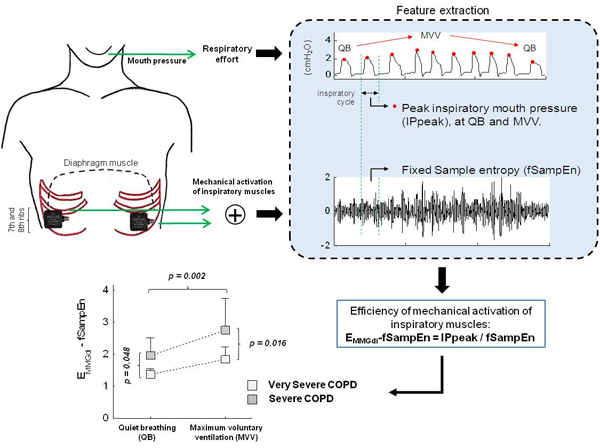 Una colaboración entre el grupo de Procesamiento e Interpretación de Señales Biomédicas del IBEC y dos hospitales locales ha dado lugar a un nuevo método no invasivo de evaluar la eficiencia de los músculos respiratorios en pacientes con enfermedad pulmonar obstructiva crónica (EPOC).
La disfunción muscular respiratoria es un problema común en los pacientes con EPOC, ,mayormente relacionados con la hiperinflación pulmonar. El acostamiento del diafragma y los cambios perjudiciales en la relación fuerza-longitud del músculo causan una reducción de la capacidad de los músculos para generar presión, colocándolos en desventaja mecánica.
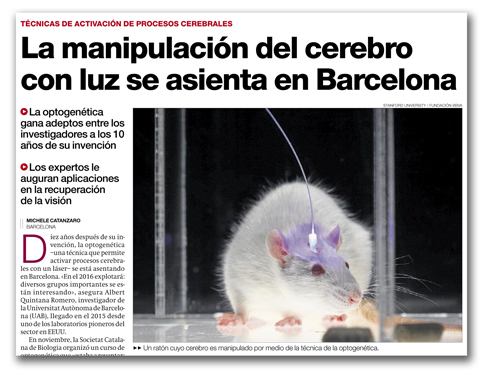
 El investiogador principal del IBEC y profesor investigador ICREA Pau Gorostiza aparece en un artículo de El Periódico hablando sobre la optogenética, que está en auge en Barcelona.
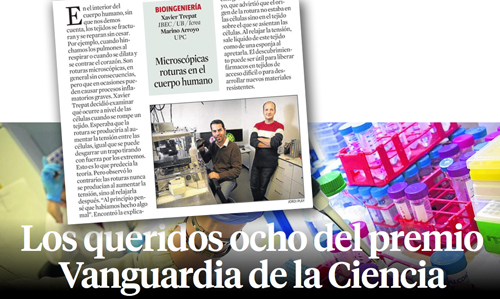 El investigador principal del IBEC y profesor investigador ICREA es uno de los ocho candidatos nominados a la edición de este año del Premio de Ciencias de La Vanguardia.
Durante cuatro semanas, La Vanguardia invita a los lectores a votar por el científico o científicos españoles que crean que han hecho la investigación más importante en el último año. Los ocho finalistas seleccionados por el Comité Científico Asesor del premio, que está organizado por la Fundación Catalunya-La Pedrera Grupo Godó, se han seleccionado en función de su excelencia científica, con la única condición de que todos ellos estén afiliados a una organización española.
«Detecció d’estats inadequats per la conducció de un vehicle a partir de la degradació del control dinàmic”
«Detecció d’estats inadequats per la conducció de un vehicle a partir de la degradació del control dinàmic”
 La plataforma Española de Nanomedicina, coordinada por el IBEC, NanoMedSpain organiza un evento que forma part del Nano World Cancer Day 2016 en Martes 2 de Febrero, una iniciativa global organizada por el World Cancer Day.
En la conferencia, que tendrá lugar a partir de las 11: 00h hasta las 13: 00h en el Aula Magna de la Universidad de Barcelona, las últimas innovaciones en nanomedicina para el cáncer serán presentadas y discutidas, con temas que van desde el diagnóstico precoz y la liberación controlada de fármacos a la terapia de radiación utilizando nanopartículas.
Tissues in our body can be extremely soft such as breast or brain, or very stiff such as bone. Cells in our body constantly interact mechanically with such tissues, exerting, … Read more