REVISTA CAPITAL: El talento que impulsa la investigación del futuro
Las becas de la Fundación ‘la Caixa’ espolean las carreras investigadoras en el ámbito de la salud. Irene Marco: “Sin esta beca, seguramente no habría vuelto a España”.
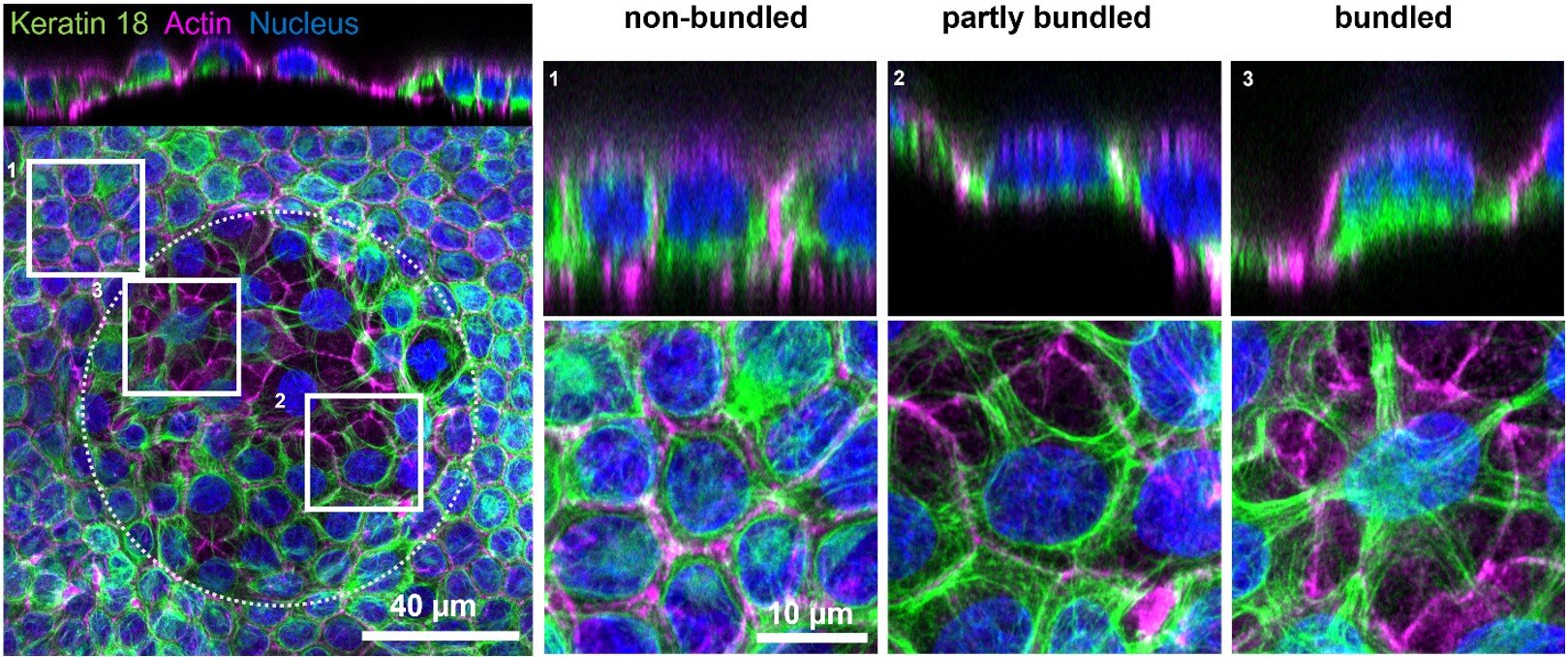
Researchers at IBEC have discovered that epithelial tissues adapt to prolonged stretching by slowly reorganising their keratin cytoskeleton into large multicellular networks. Using advanced live imaging, engineered tissue models and computational simulations, the team found that this process eventually pushes the cell nucleus out of its surrounding keratin cage. The findings reveal a previously unknown mechanism by which tissues respond to sustained mechanical stress, with potential implications for development, organ physiology and diseases linked to defective keratin organisation.
How do tissues cope with being stretched for hours or even days? A study led by researchers at the Institute for Bioengineering of Catalonia (IBEC) has uncovered an unexpected answer: Cells radically reorganize their internal scaffolding and, in the process, release their nuclei from a protective keratin network.
Entrevista a la investigadora Rosalba Sortino, sobre los fármacos activados por luz que restauran la visión en ratones ciegos.
El Instituto de Biotecnología de Cataluña lidera una investigación que ha desarrollado un fármaco en forma de colirio que permite recuperar la visión en ratones ciegos, con ensayos clínicos previstos en humanos en cuatro años. Declaraciones de Rosalba Sortino, autora del estudio Instituto de bioingeniería de Cataluña.; Joaquín Martínez Tambella, coautor del estudio Instituto de Biotecnología de Cataluña.
Un farmaco attivato dalla luce ha ripristinato la vista nei topi: funziona come una sorta di ‘protesi molecolare’ che sostituisce i sensori della retina ormai degenerati a causa della malattia, riattivando il circuito che trasporta i segnali al cervello.
Un consorcio internacional liderado por el IBEC ha desarrollado unos compuestos inteligentes que imitan las células fotorreceptoras dañadas en algunas enfermedades degenerativas. El avance abre la puerta a futuros tratamientos no invasivos mediante colirios.
Actúa como una prótesis moleculares sin necesidad de implantes, tal y como se ha probado en una investigación dirigida por el Instituto de Bioingeniería de Cataluña, que espera iniciar los ensayos clínicos en humanos en dos o cuatro años
A consortium led by the Institute for Bioengineering of Catalonia (IBEC) developed this approach based on photopharmacology, a technique to reversibly control drug activity with light. The newly developed compounds, called prosthe6, mimic the function of photoreceptor cells, which degenerate in blinding diseases such as age-related macular degeneration (AMD) and retinitis pigmentosa (RP). These photoswitchable molecules show preliminary safety profiles and represent potential drug candidates for restoring vision in patients with degenerative retinal diseases, without the need for genetic manipulation or implanted devices.
Xavier Trepat and his team at the Institute for Bioengineering of Catalonia (IBEC) are key partners in ALIVE: Active Living Matter — Information, Vitality, and Emergence, an international research programme selected for funding through the first European edition of the Novo Nordisk Foundation Challenge Programme. Coordinated by the Niels Bohr Institute in Copenhagen, the project will receive 75 million DKK (around €10 million) over six years to uncover how information flows drive the emergence, organisation and function of living tissues.