A research team led by the Institute for Bioengineering of Catalonia (IBEC) has developed an innovative, portable, smartphone-based system for assessing sleep apnoea in individuals with different health conditions. The study, published in IEEE Transactions on Neural Systems and Rehabilitation Engineering, in collaboration with the Guttmann Institute, shows that this technology can facilitate the early detection of a common but underdiagnosed disorder, which negatively impacts the recovery and rehabilitation of patients who have suffered a stroke.
Sleep apnoea is a disorder characterised by repeated obstructions or collapses of the upper airway during sleep. These interruptions to breathing reduce the amount of oxygen in the blood. Stroke patients are at high risk, as they experience poorer sleep quality and have a higher prevalence of sleep disorders, such as insomnia and respiratory problems. It is estimated that over 50% of stroke survivors have sleep apnoea. However, they have limited access to sleep studies due to their multiple health complications, and current diagnostic techniques such as polysomnography are uncomfortable, complex and expensive.
A study led by the Institute for Bioengineering of Catalonia (IBEC), in collaboration with the Guttmann Institute, has now presented the first application of a smartphone-based system for the early detection and monitoring of sleep apnoea in stroke patients.
Led by Raimon Jané, a professor at UPC and principal investigator at IBEC and CIBER-BBN, as well as leader of IBEC’s Biomedical Signal Processing and Interpretation (BIOSPIN) group, the work has been published in the IEEE Transactions on Neural Systems and Rehabilitation Engineering journal.
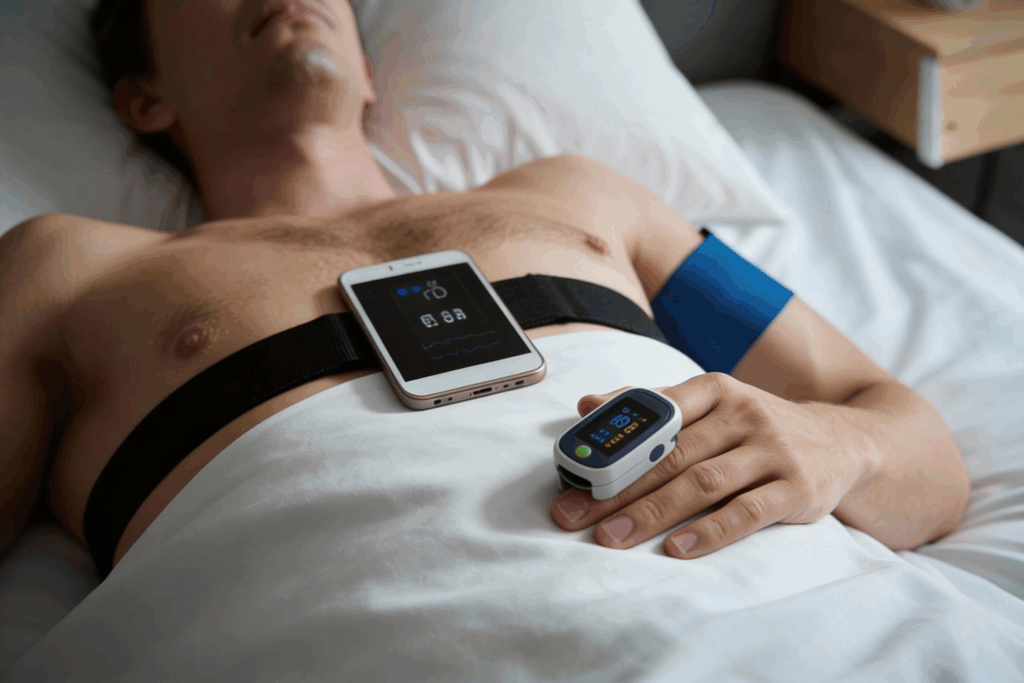
Due to the limited availability of polysomnography, smartphones provide a straightforward, portable solution that increases access to sleep studies, enabling a larger number of patients to be evaluated and potentially improving their overall health. The new system uses the sensors built into smartphones and a wireless pulse oximeter to record acoustic, movement and oxygenation signals during the night. This allows multimodal digital biomarkers related to breathing, body position and oxygen saturation to be extracted.
According to Jané, “Integrating digital biomarkers obtained with smartphones can improve the detection, understanding and management of sleep apnoea after a stroke, reducing its clinical impact and promoting functional recovery”.
The study involved 30 patients in the subacute phase of stroke and 30 people who had not suffered a stroke (17 men and 13 women) aged between 33 and 63. The results revealed that 67% of stroke patients suffered from moderate to severe sleep apnoea, compared to 40% of the control group. Severe apnoea was found in 40% of stroke patients, compared to 7% of the control group.
The study provided a detailed description of sleep apnoea and positional patterns after stroke, as well as a comparison with a control group without disability. We observed a high prevalence of sleep apnoea, mouth breathing, and a supine sleeping position in stroke survivors — factors that contribute to airway obstruction.
Yolanda Castillo is an IBEC researcher and the study’s first author.
This new approach opens the door to incorporating a simple, accessible, portable tool for sleep monitoring in clinical and home settings, especially in the early stages of post-stroke rehabilitation.
The work highlights the potential of mobile technology to democratise access to sleep studies and enable more personalised care for neurological patients.
Referenced article:
Yolanda Castillo-Escario, Sergiu Albu, Hatice Kumru, and Raimon Jané. Evaluation of Sleep Apnea in Stroke Patients Using a Portable Smartphone-Based System. IEEE Transactions on Neural Systems and Rehabilitation Engineering (2025). DOI: 10.1109/TNSRE.2025.3628132


