Today, researchers, clinicians and innovation experts gathered at a conference organised by the Institute for Bioengineering of Catalonia (IBEC) as part of Barcelona Health Innovation Week 2026. The conference focused on accelerating the transfer of results towards a more personalised, preventive and sustainable future of medicine. The session emphasised the importance of strengthening interdisciplinary alliances to bring scientific advances to patients sooner, and highlighted the role of the Catalan biomedical ecosystem and the progress made by the Complementary Plan for Biotechnology Applied to Health in Catalonia.
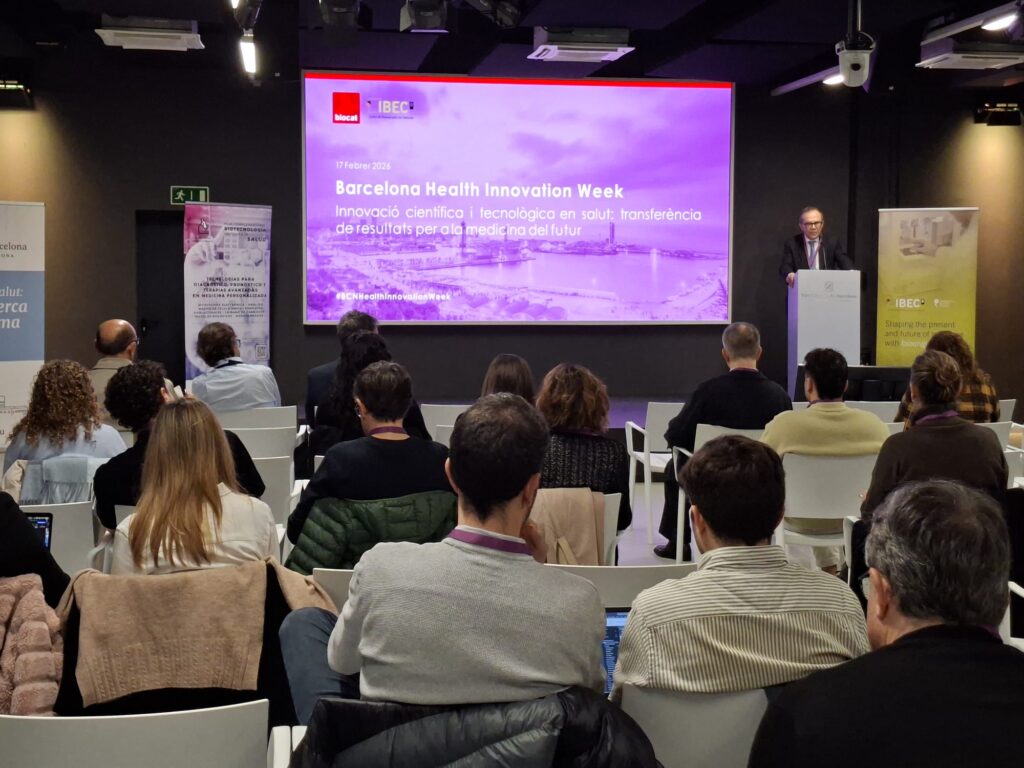
Today, Barcelona hosted the ‘Scientific and Technological Innovation in Health: Transferring Results for the Medicine of the Future’, as part of the fourth Barcelona Health Innovation Week. From 16 to 20 February, the event will transform the city into a meeting point for start-ups, hospitals, research centres, and investors in the healthcare sector. The conference, which is dedicated to promoting knowledge transfer in biomedicine, was attended by representatives from hospitals, research centres, technology organisations and government bodies. These representatives shared experiences and strategies for accelerating the clinical impact of science.
The Complementary Plan for Biotechnology Applied to Health has sought to bring together basic and clinical research to accelerate the arrival of innovation in society.
Josep Samitier
The meeting brought together key Catalan healthcare and scientific institutions with the aim of fostering synergies and moving towards a more agile, cooperative and patient-centred innovation model. The event also marked the official closure of the Complementary Plan for Biotechnology Applied to Health in Catalonia, which has promoted the development of innovative technologies in diagnosis, prognosis and advanced therapies for three years.
At the opening ceremony, Josep Samitier, the Plan’s national scientific coordinator and deputy director of IBEC, emphasised that this inaugural edition had demonstrated the critical importance of collaboration between scientific institutions, hospitals, companies and administrations for accelerating the delivery of biomedical innovation to society. ‘The Plan has sought to bring together basic and clinical research to accelerate the arrival of innovation in society,’ he concluded.
The conference included short presentations by researchers involved in various areas of the Complementary Plan in Catalonia.
Action Line 6: Advanced Therapies, Surgical Training and Medical Robotics
Manel Juan (FRCB-IDIBAPS) presented advances in scaling up the production of lentiviral vectors to improve access to gene therapies, such as CAR-T. This will have a direct impact on the number of patients who will be able to benefit from these treatments.
Robert Teixidó (IQS) presented progress on the Biomod project, which is being developed in collaboration with Sant Joan de Déu Hospital (HSJD) and focuses on customised alveolar grafts for cleft lip and palate. Through the analysis of image banks and biomechanical models, the team has developed a library of cases and a stress map that enables more accurate prediction of graft integration. The team has already submitted a first article and is preparing a second, while new collaborations in AI and personalised surgery have also been initiated.
Pamela Lustig (HSJD) presented 3D surgical simulators and virtual reality tools for complex childhood cancer interventions, such as those for neuroblastoma or Wilms’ tumour. Surgeons have highlighted that these technologies reduce operating times, decrease stress levels and enhance decision-making processes, thereby facilitating faster patient recovery.
Line of Action 4: Biological models for screening and therapeutic studies
Pau Sancho-Bru (FRCB-IDIBAPS) presented the latest developments in personalised models of MASLD liver disease. These models use organoids derived from patient biopsies to faithfully reproduce the cellular heterogeneity of the liver, enabling the metabolism and progression of the disease to be studied.
Stefan Hummer (VHIR) presented research results on phosphorylation and poor prognosis in cancer, and announced plans to create a spin-off in 2026.
Julián Cerón (IDIBELL) explained how they have used C. elegans and CRISPR techniques to evaluate the impact of PTEN gene mutations and understand why genetically identical tumours can behave differently.
Antoni Caimari (EURECAT) presented a preclinical model for studying the microbiota-gut-brain connection in Alzheimer’s disease. This model demonstrates that transplanting microbiota from patients to healthy mice significantly alters cognitive behaviour, generating very promising results.
Action Line 3: Drug Screening and Interaction Analysis
Marc Torrent (UAB) presented the design of personalised ‘smart antibiotics’ that avoid affecting the microbiota. Following the screening of over 100,000 compounds, 16 compounds with antimicrobial activity were identified, of which two are now in the advanced development funding phase.
Jordi Surrallés (HSCSP) presented chemoprevention strategies for patients with Fanconi anaemia that focus on reactivating DNA repair pathways through drug repositioning.
Begoña Cánovas (IRB Barcelona) presented new approaches to treating metastatic osteosarcoma using phenotypic screening in patient-derived models. A repositionable drug with therapeutic potential has been identified.
Kevin Aguilar (IRB Barcelona) presented advances in the treatment of rare mitochondrial diseases such as COXPD1. A screening of 150,000 compounds produced 15 candidates, and gene therapy studies in animal models reversed biochemical alterations, opening up new therapeutic avenues.
Action Line 2: Databases and Computational Integration for Precision Medicine
Lorena Alonso (BSC-CNS) presented predictive models for type 2 diabetes, incorporating genetic, clinical, and environmental data from over 442,000 individuals. The team has identified 184 genes associated with risk subgroups and generated new epigenetic data to inform preventive strategies.
Salvador Capella (BSC-CNS) presented the Datos-CAT project, which focuses on interoperability, visibility, and the utilisation of population cohorts — a critical factor in advancing translational models.
Ester Ballana (IrsiCaixa) discussed immunomodulation in metastatic breast cancer, which is responsible for 20% of advanced cases in women, highlighting the need for new therapeutic approaches.
Luciano Di Croce (CRG) presented advances in brain organoids and in vivo models for studying diffuse midline glioma (DMG), a devastating and incurable paediatric cancer.
Roundtable discussion: challenges and opportunities for accelerating innovation
The event also featured a round table discussion in which representatives from the regulatory, clinical, business, government and investment sectors analysed the barriers that still hinder innovation from reaching the healthcare system: Raquel Yotti (Commissioner for PERTE Health at the Forefront, Ministry of Science, Innovation and Universities), Javier Selva (Director General of Transfer and Knowledge Society, Government of Catalonia), Clara Campàs (Co-founder of Asabys Partners), Joaquín Bonelli (Head of the Projects and Innovation Department, IRBLLEIDA) and Clara Prats (Chair of the Board of Directors of the Interdisciplinary Group of Health Professionals Association (GIPS).
Participants agreed that mismatches between the timelines and priorities of science, industry, regulation and funding continue to slow down the transition of R&D results into real clinical applications. They also emphasised that regulatory processes continue to be a bottleneck, and that the healthcare system requires greater incentives to adopt new technologies.
Another key topic was the importance of integrating multidisciplinary profiles, such as engineers, biotechnologists and data experts, to facilitate innovation in hospitals. The importance of stable, long-term funding was emphasised, so projects with transformative potential can be consolidated. The speakers also emphasised the importance of including patients and citizens in the development of solutions as an essential means of ensuring equity and guiding innovation towards real needs.
In closing, the experts concluded that the future of biomedicine depends not only on research and technology, but also on the ecosystem’s capacity for coordination, collaboration, and talent attraction to sustain these transformations.
Action Line 2 — ScreenTech Programme
Maria Macías (IRB Barcelona) focused her presentation on SMAD proteins and new avenues for treating diseases that currently lack effective therapies, such as certain types of tumours and Myhre syndrome. SMADs are key components of cell signalling but are often altered in pathological processes.
Alexandre Calon (IMIM) presented the latest results of the TMETherapy project, which proposes using patient-derived colorectal cancer models (mini-tumours) that are resistant to treatment induced by the tumour microenvironment, together with a screening approach to find new drugs.
Alejandro Vaquero (IJC) and Eduardo Domínguez (USC) addressed the identification of modulators of the ADP-ribosyl transferase activity of sirtuins, enzymes that play a key role in the response to stress, with potential therapeutic use in leukaemia.
Marina Bataller (VHIR) presented the progress made in the ANTCARES project, which focuses on a new therapy based on molecular degraders to sensitise head and neck tumour cells (HNSCC) that are resistant to conventional therapies.
Miguel Martín (UB) concluded the session by detailing his research focused on the use of mass screening methods to identify new molecules capable of inhibiting the activity of enzymes that act in protein lipidation, to treat metastasis in preclinical models, with the aim of bringing them closer to clinical use.
The conference concluded with a joint call to strengthen the Catalan biomedical innovation ecosystem through cooperation, scientific excellence and the collective will to transform knowledge into real solutions to improve patients’ quality of life.

The Complementary Plan for Health Applied Biotechnology has been co‑funded by the Ministry of Science, Innovation and Universities with European Union NextGenerationEU funds, within the Recovery, Transformation and Resilience Plan (PRTR‑C17.I1).


