
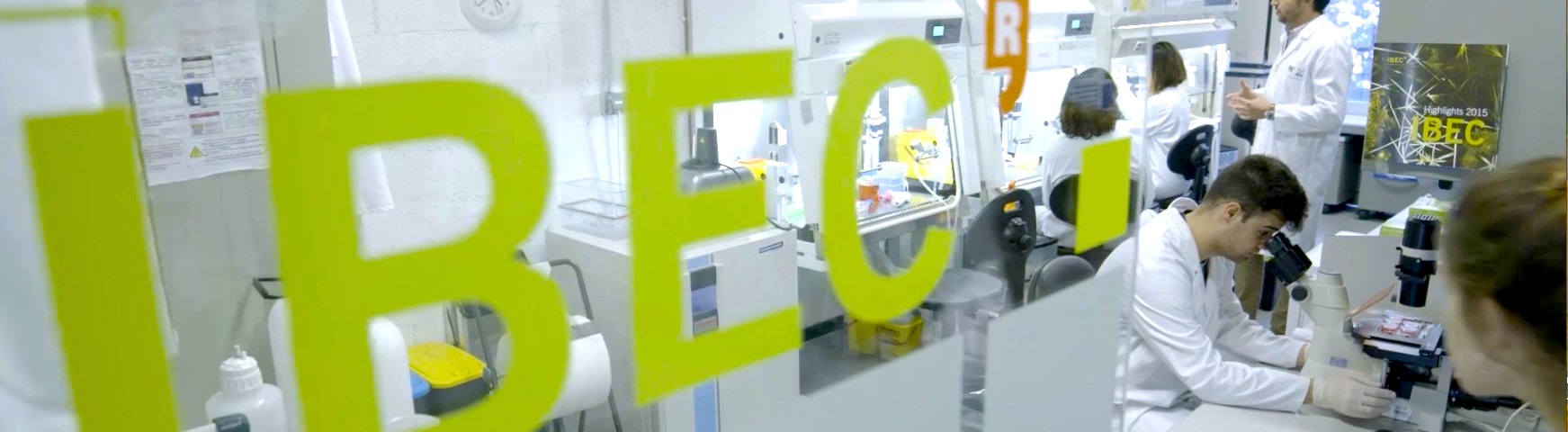
On 3 February, the 11th edition of Nano World Cancer Day took place, a leading event promoted by Nanomed Spain, the platform that coordinates the Spanish nanomedicine ecosystem, coordinated by the Institute for Bioengineering of Catalonia (IBEC). The conference brought together representatives from research, clinical practice, industry and patient associations with the aim of strengthening collaboration among key players and accelerating the arrival of solutions based on oncological nanomedicine in society.
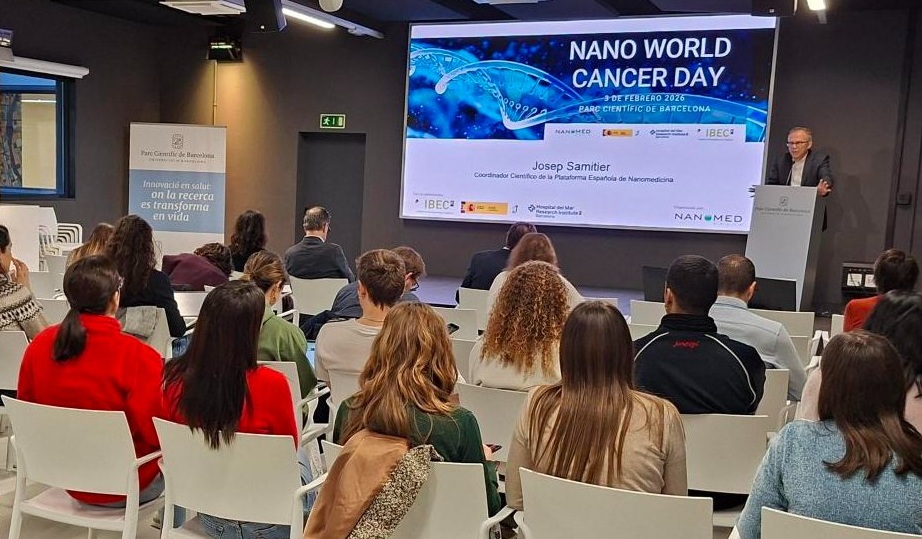
On 3 February, the Barcelona Science Park (PCB) hosted the 11th edition of Nano World Cancer Day. The event was opened by Josep Samitier, Scientific Coordinator of NANOMED Spain, and Joaquín Arribas, Director of the Hospital del Mar Research Institute Barcelona. Samitier highlighted that biomedical research is experiencing a period of extraordinary scientific and technological advances in the context of precision medicine. In this scenario, he emphasised that the main mission of the Nanomed Spain platform is to connect all the actors involved—hospitals, research centres, universities, companies, technology centres and patient associations—to ensure that innovations effectively reach society. Arribas, in turn, highlighted the Hospital del Mar Research Institute Barcelona’s aspiration to become a driving force behind new nanomedicine-based therapies for the treatment of cancer. Both reinforced the message that Nano World Cancer Day is an event that seeks to consolidate synergies and collaborations that enable real nanomedicine-based solutions to be brought to patients.
In his speech, Luis Àlvarez Vallina — Director of the Cell Therapy and Human-Derived Substances Programme at the Hospital del Mar Research Institute in Barcelona, and Director of Research at the Blood and Tissue Bank — highlighted the value of strategic collaborations in transforming research projects into therapeutic solutions for patients who currently have no options. He also emphasised the strength of the Catalan research ecosystem, which offers unique opportunities to integrate scientific excellence with large-scale manufacturing and production capabilities. This facilitates the faster and safer translation of advances into the clinical setting.
The scientific programme included the participation of Maria de la Fuente, who presented the activity of the spin-off DIVERSA Technologies, founded in 2018 with the aim of developing new therapeutic strategies and accelerating their arrival in the clinic through its own nanotechnology platform. Her presentation highlighted the role of technology-based companies as a bridge between academic research and the development of applicable therapeutic solutions.
Núria Gavalda, Director of Strategy and Innovation at the Blood and Tissue Bank, in turn, explained the role of this institution as a multidisciplinary infrastructure that acts as a link between research and clinical production, advancing innovation in gene and cell therapies and adapting to different diseases and healthcare needs.
From the field of fundamental research, Giuseppe Battaglia, ICREA research professor and principal investigator of the Molecular Bionics group at the Institute for Bioengineering of Catalonia (IBEC), presented his team’s latest results, focused on optimising the selectivity of interactions between receptors and ligands and on the development of nanoparticles using ‘supramolecular engineering’ strategies. This approach, based on multiple binding sites, seeks to increase the selectivity and efficacy of nanotherapeutic systems.
The patient’s perspective and social impact were represented by Sofía Cabezudo, from the Spanish Association Against Cancer (AECC), who recalled that the organisation’s mission is to minimise the impact of the disease through a comprehensive approach that includes patients and their families. She explained that the AECC’s four pillars for achieving a 70% survival rate are funding, support for talent, innovation and patients, and highlighted that since 2017, the AECC’s cumulative investment in cancer-oriented nanomedicine projects has amounted to €8.7 million.
The 11th edition of Nano World Cancer Day once again highlighted the potential of nanomedicine as a driver of innovation in oncology and the importance of strengthening collaboration between research, clinical practice, industry and institutions. The meeting consolidated its role as a strategic forum for promoting the translation of scientific advances into therapeutic solutions that respond to real clinical needs, with the patient at the centre.


