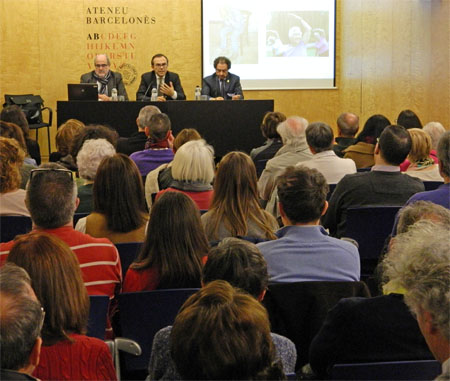
IBEC Seminar: Roberto de la Rica
Bioplasmonics in nanofabrication, biosensing and nanomedicine
PhD Discussion sessions are open to all staff and researchers at all career stages, and are intended to help PhD students gain feedback from colleagues by presenting their research results and discussing them with each other, as well as with more experienced researchers.
IBEC group leader Samuel Sánchez was one of the experts invited to attend the Innovators Under 35 European Summit in Brussels last week, a gathering of the European winners of MIT Technology Review’s “Innovators under 35” list.Samuel gave a talk, “The Evolution of Nanorobots”, at the event, which brought together the winners of the prestigious recognition from Germany, Belgium, France, Italy and Poland as well as Spain. The summit aimed to create a strong community of those innovators recognized annually by the prestigious publication to share their knowledge and experience in fields ranging from nanotechnology and energy to software or transportation.

Application Deadline: 22/06/2016
Ref: BS-SM
The Biomimetic systems for cell engineering group at the Institute for Bioengineering of Catalonia (IBEC) is looking for a Postdoctoral Researcher to participate in the development of the project “Engineering Complex Intestinal Epithelial Tissue Models” (ERC-Consolidator Grant). The goal of this project is to engineer intestinal epithelial tissue models that mimic physiological characteristics found in in vivo human intestinal tissue, to open up new areas of research on human intestinal diseases. To do this, we propose to develop an experimental setup that combines microfabrication techniques, tissue engineering components and recent advances in intestinal stem cell research, exploiting stem cell self-organizing characteristics. We anticipate this setup to recapitulate the 3D morphology, the spatio-chemical gradients and the dynamic microenvironment of the living tissue. We expect the new device to prove useful in understanding cell physiology, adult stem cell behavior, and organ development as well as in modelling human intestinal diseases.
Having measured the electric polarizability of DNA – a fundamental property that directly influences its biological functions – for the first time ever last year, IBEC´s Nanoscale Bioelectrical Characterization group has made a further breakthrough in the understanding of the dielectric properties of cell constituents by measuring the electric polarizability of the main components of the cell membrane – namely lipids, sterols and proteins – with a spatial resolution down to 50nm.The cell membrane plays an essential role in fundamental bioelectric phenomena. Found in places such as neurons or cardiac cells, it regulates the exchange of ions between the cell and the environment, as well as enabling the formation of electric potentials that can propagate over long distances.
“Development of a nano-sensor for the direct electrical free-label detection of DNA’s hybridisation and single nucleotide polymorphism”