IBEC-IRB Barcelona joint seminar: Guillaume Salbreux, Francis Crick Institute
Physics of epithelial flows and folds

Physics of epithelial flows and folds
Physics of epithelial flows and folds
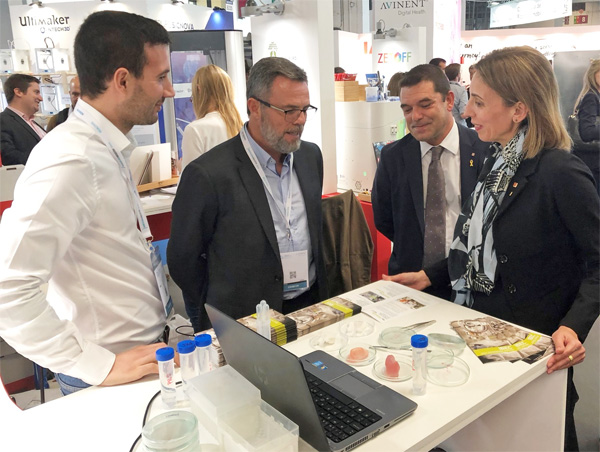
 Last week IBEC attended the third edition of “IN(3D)USTRY: From Needs to Solutions”, the international meeting devoted to 3D printing.
The institute had a stand in the exhibition area, where Head of Technology Transfer Xavier Rubies and Technology Transfer manager Xavier Puñet welcomed visitors interested in finding out more about IBEC’s 3D bioprinting capabilities.
The Generalitat de Catalunya’s Minister of Enterprise and Knowledge, Àngels Chacón (right), was interested to hear about IBEC’s medical solutions using 3D bioprinting for bone, cartilage, skin, diagnostic, cardiology and muscle.

Abans del: 31/10/2018
Ref: PT-XR
La Posició de a Promotor Tecnològic té com a objectiu donar support a la unitat de Transferência Tecnològica de l’ Institute for Bioengineering of Catalonia (IBEC) en el procés d’obtenció de l’acreditació del segell TECNIO. Tant en la fase de presentació de la proposta com en la posterior d’implantació del sistema de qualitat fins a passar l’auditoria adient.
Sensing the matrix: transducing mechanical signals from integrins to the nucleus
Sensing the matrix: transducing mechanical signals from integrins to the nucleus
Sensing the matrix: transducing mechanical signals from integrins to the nucleus
Sensing the matrix: transducing mechanical signals from integrins to the nucleus
 IBEC Director Josep Samitier is one of the experts quoted in an article in ARA magazine yesterday that reviews the university system in Catalonia.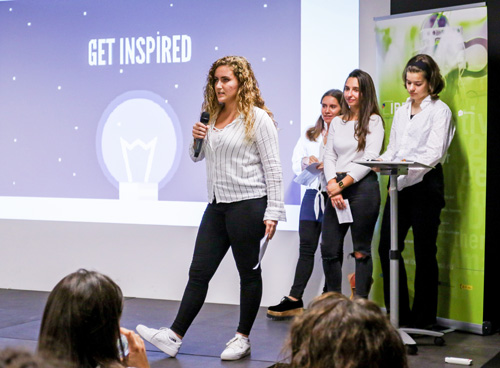
 On Friday 19th October, an event to round off the Fundació Catalunya La Pedrera’s ‘Bojos per la ciència’ (‘Crazy for Science’) initiative took place at IBEC.
This year was the first year that IBEC took part in the ‘Bojos’ initiative, with a course devoted to bioengineering. 25 students have been coming to IBEC on eighteen Saturdays between January and October to attend in theoretical and practical sessions about the main areas of research in bioengineering applied to health: controlled drug release, biomaterials, regenerative therapies and the medicine of the future, among other topics. In addition, the students participated in complementary workshops where they looked at ethical questions and scientific communication, as well as getting hands-on experience of the research laboratory environment.