

About
Exploring the Brain with Light: The NPN Group at IBEC
The Nonlinear Photonics for Neuroscience (NPN) group at IBEC is dedicated to advancing our understanding of the brain through the development of cutting-edge microscopy techniques. Our work is guided by the belief that breakthroughs in neuroscience often stem from technological innovations, with photonic tools playing a leading role.
At the intersection of physics, engineering, and neuroscience, our research focuses on three core objectives:
- Leveraging Nonlinear Optical Phenomena: We study effects like two-photon excited fluorescence and second harmonic generation and enhance them by precisely shaping ultrafast laser beams in both space and time.
- Pioneering New Microscopy Techniques: Building on our optical expertise, we develop innovative imaging and photostimulation tools that could provide deeper insights into the role of neuronal circuits.
- Applications in Neuroscience: We partner with leading neuroscientists to apply our technologies to the study of neuronal circuits in small animal models, aiming to help deciphering brain functions.
Shining Light on the Brain’s Mysteries
Neuronal circuits are the brain’s fundamental units, responsible for processing information from the world around us. They shape our perceptions, guide our actions, and define our identities. Understanding how neuronal circuits work is one of the greatest scientific challenges of our time, which requires extremely sophisticated tools to probe them.
In the past 15 years, the field of neurophotonics has revolutionized neuroscience by enabling us to visualize and manipulate brain activity with light. Fluorescent indicators allow us to see neurons “fire”, while optogenetic techniques give us the power to control neural activity using light. However, the ability to truly decipher the brain’s complex networks depends on the continued development of powerful microscopy techniques.
At the NPN group, we design build and apply state-of-the-art microscopy tools for neuroscience. Our mission is to provide the scientific community with the technologies needed to illuminate the brain’s mysteries.
Visit our external website to find out more.
Staff
 ibecbarcelona.eu
Publications
Check for more detailed information on the outputs of the Group at IBEC CRIS portal.
Publications list:
Equipment
Equipment used
- Ultrafast infrared lases: The heartbeat of our experiments, these state-of-the-art lasers generate intense pulses for high-resolution imaging and photostimulation. Our team customizes optical setups to direct each pulse precisely in space and time, driving innovative research in microscopy and neurobiology.
- Spatial light modulators: These modulators enable us to fine-tune laser beams, guiding them to precise spatial locations or altering their temporal profiles. They are essential tools for customizing light to meet our experimental needs.
- Microscopes: We develop novel microscopy techniques to make brain study more accessible, versatile, and precise. Our goal is to provide the tools that help unravel the mysteries of the brain from every possible angle.
News

IBEC showcases cutting-edge biomedical innovation at the Health Revolution Congress 2026
The Institute for Bioengineering of Catalonia brought together researchers, investors and industry leaders with its event “IBEC Health Revolution Day: Engineering the Future of Medicine”, as part of the Health Revolution Congress. Through expert panels, technology pitches and scientific talks, the event showcased cutting-edge biomedical technologies and discussed how to translate scientific discoveries into real-world healthcare solutions.

Three IBEC projects receive ERC Proof of Concept funding to drive innovation in health, neuroscience, and biomedical technology
Dr Benedetta Bolognesi, Dr Irene Marco-Rius and Dr Nicolò Accanto, who are all principal investigators at IBEC, have each been awarded a prestigious ERC Proof of Concept grant. These grants are awarded by the European Research Council to support the exploration of the commercial and societal potential of research projects conducted within European institutions. The three winning projects range from new platforms for discovering antiamyloid drugs, to advanced metabolic analysis technologies, to optical tools for studying the brains of animals moving naturally.
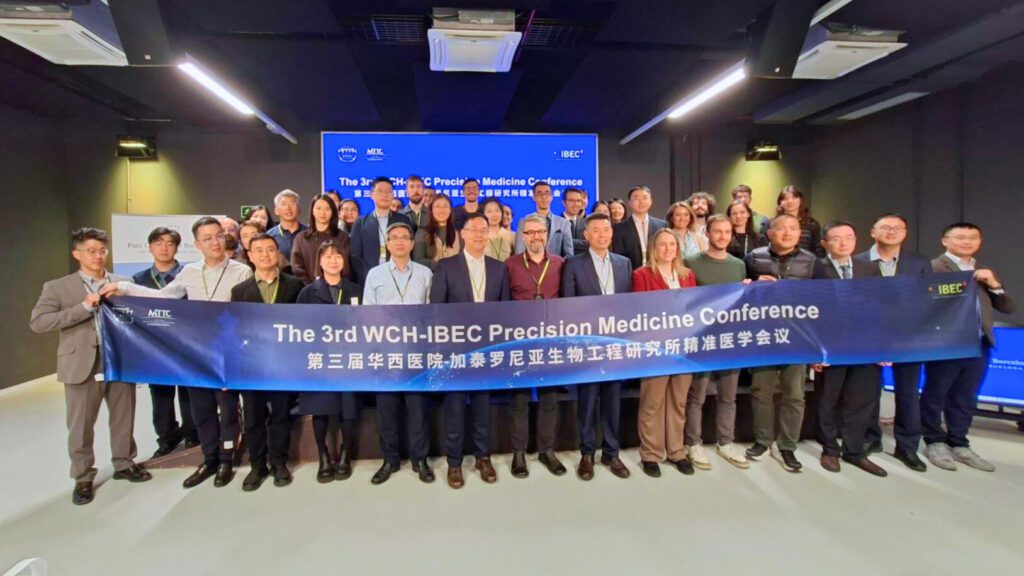
The IBEC and West China Hospital hold their third joint conference on precision medicine in Barcelona
Barcelona hosted the third IBEC-WCH Precision Medicine Conference this week, an event that further strengthened the strategic alliance between the Institute for Bioengineering of Catalonia (IBEC) and the West China Hospital of Sichuan University (WCHSU). The Chinese delegation visited Spain from 26 to 29 November, taking part in a busy schedule of scientific and institutional activities and exchanges between the two centres.

IBEC welcomes two new research groups
The Institute for Bioengineering of Catalonia (IBEC) has welcomed two new research groups this year, led by ICREA Research Professor Javier G. Fernández and Dr Nicolò Accanto respectively. Dr Fernández’s Biointegrated Materials and Engineering group aims to integrate biological principles and living components into engineering systems, marking the beginning of the “Era of Biomaterials”. Meanwhile, Accanto’s Nonlinear photonics for neuroscience group is developing advanced optical technologies to help us understand the mechanisms that govern neuronal activity.
Jobs
Postdoctoral Researcher at the Nonlinear Photonics for Neuroscience Research Group
PR-NA // Deadline: 10/07/2026
PhD at the Nonlinear Photonics for Neuroscience Research Group
Ref: PhD_NA // Deadline: 03/08/2025
PhD at the Nonlinear Photonics for Neuroscience Research Group
Ref: PhD-NA // Deadline: 18/06/2025