Cells move en masse towards rigid tissues
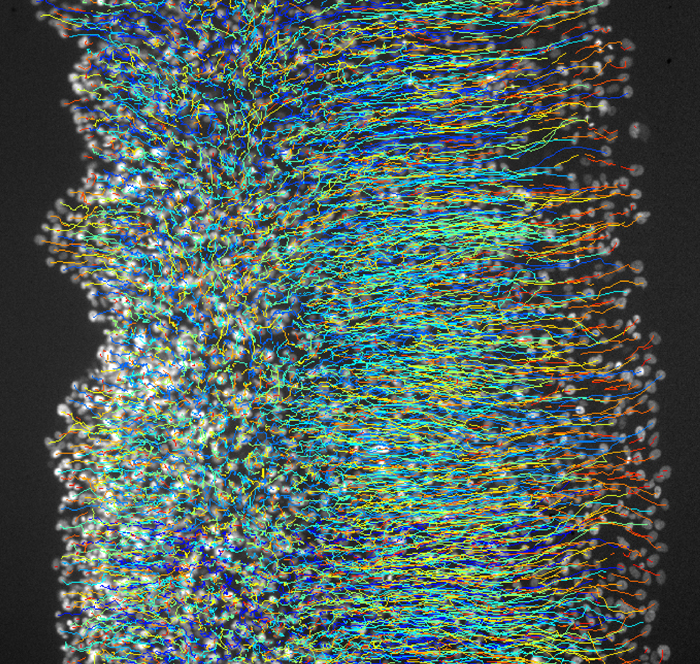
A new phenomenon, collective durotaxis, opens new avenues to control tumor growth and improve wound healing

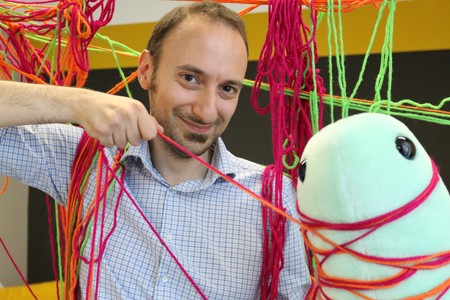 Lorenzo Albertazzi and ‘Gripin’ the virus have made it into the 2016 AXA Research Fund Photo Contest, a competition that challenges scientists to capture their AXA Research Fund project in a single image.
Lorenzo’s photo (left) – taken at IBEC with the help of the Communcications Team – shows him grappling with the ‘virus’, which have the ability to mutate, change, and become resistant to treatments.
With AXA funding, his research group at IBEC is creating resistance-free therapies based on nanofibers that can wrap around a virus like yarn, stopping disease from spreading. “I’d like viruses to be as big as the one in the photo,” says Lorenzo. “It would make our job a lot easier!”
The photo, along with 13 other semi-finalists, has been posted to a dedicated Facebook gallery at which the public can vote during September by “Liking” a photo.
 IBEC now has Wikipedia entries in English, Spanish and Catalan.
Wikipedia is the seventh most-visited website in the world and the largest encyclopedia ever, with 5,200,000 entries in English alone. The fifteen year-old website has been described as the ‘largest collaborative effort in the history of mankind’.
As with all Wikipedia entries, the IBEC page is a ‘living’ page, and will be expanded and improved over time as the institute’s history progresses.
With these new entries, IBEC joins the category “Research institutes in Catalonia” of the free online encyclopedia, in which other centres in the Catalan research system are already present.

Application Deadline: 15/08/2016
Ref: PH-PG
The Nanoprobes and Nanoswitches group at the Institute for Bioengineering of Catalonia (IBEC) is looking for Predoctoral candidate to participate in the in the photo physical characterization of photoisomerizable muscarinic ligands to control slow wave activity with light.
Application Deadline: 15/08/2016
Ref: PD-ET
The Bacterial Infections: antimicrobial therapies group at the Institute for Bioengineering of Catalonia (IBEC) is looking for Predoctoral candidate to participate in the research in infectious diseases, understand the bacterial virulence and identification of new strategies to treat bacterial infections.
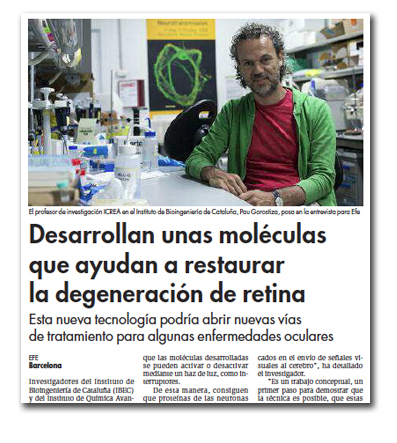 There’s been lots of press coverage of Pau Gorostiza’s group’s recent Nature Communications paper describing their development of molecules that can be applied as light-regulated molecular prostheses to help restore vision in cases of retinal degeneration.
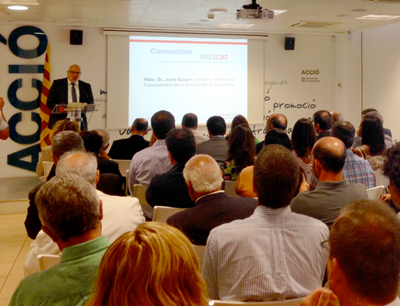 IBEC is a member of one of five ‘communities’ that will receive funding as part of the RIS3CAT intiative, which aims to enable and promote large projects in Catalonia that combine industry and research.
In the launch meeting at the headquarters of RIS3CAT coordinator ACCIO – the government’s agency for competitivity in business – on Monday, Minister for Business and Enterprise Jordi Baiget, who chaired the event alongside Director General of Industry Nuria Betriu, declared RIS3CAT “the greatest ever effort for innovation in Catalonia”.
IBEC is a member of NEXTHEALTH, one of two health-related RIS3CAT communities among the five, all of which bring together businesses, research organizations, hospitals, and other major players to form a critical mass to work in collaboration on large-scale projects to boost innovation.
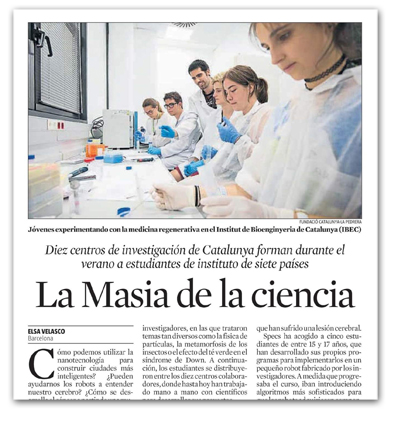 This summer’s Barcelona International Youth Science Challenge (BIYSC 2016), a new initiative that aims to stimulate scientific talent among young people, was covered in La Vanguardia today, with the photo accompanying the article taken at IBEC.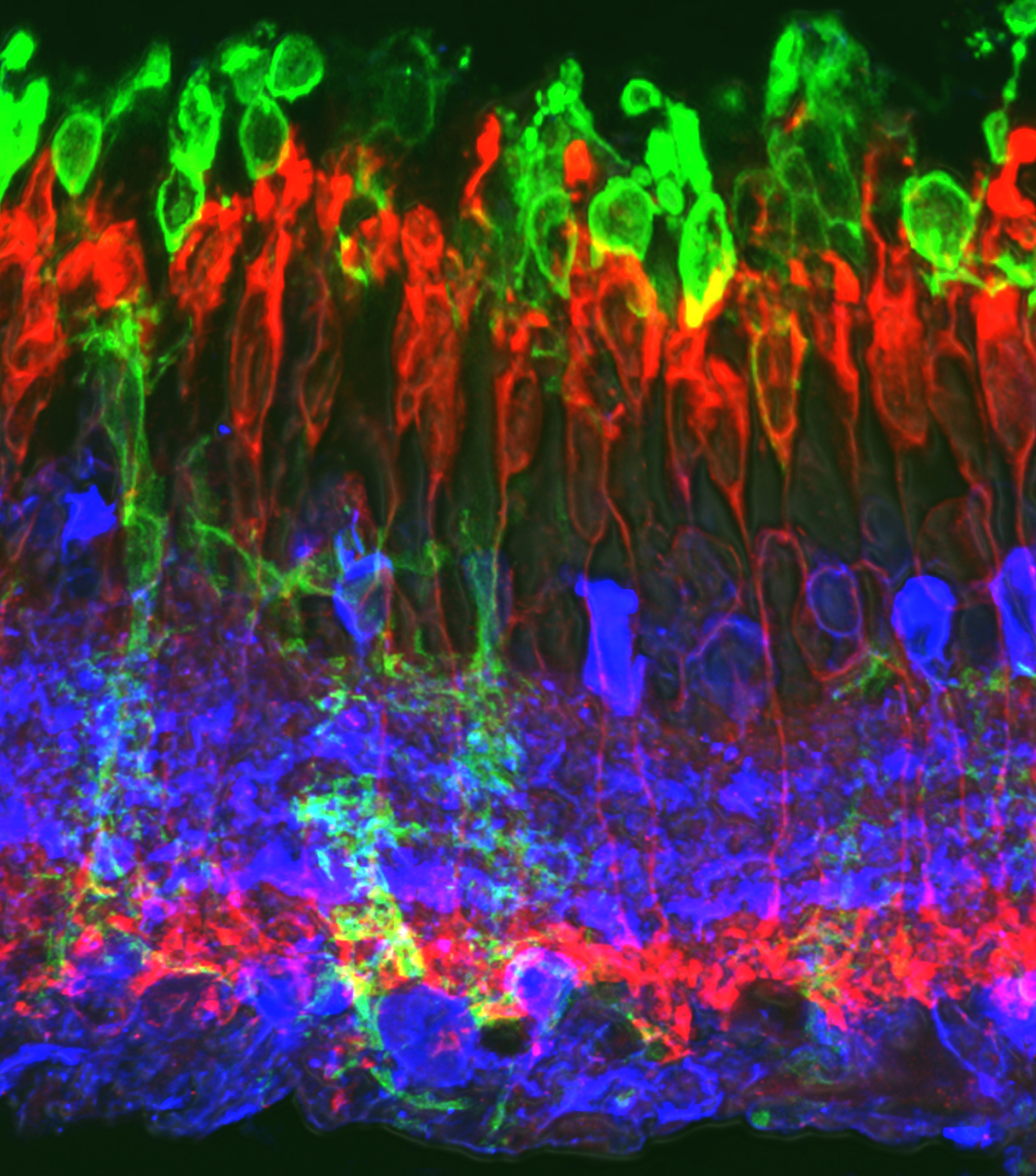
The groups of Pau Gorostiza, ICREA Research Professor at IBEC, and Amadeu Llebaria of IQAC-CSIC have developed molecules that can be applied as light-regulated molecular prostheses to help restore vision in cases of retinal degeneration.
Together with their collaborators at ICIQ, INA, IRB Barcelona, CIBER-BBN and the Miguel Hernández and Alcalá de Henares universities, the researchers reveal in Nature Communications today their development of a new class of light-regulated drug, targeted covalent photoswitches (TCPs), that act as prosthetic molecules that can restore photoresponses in degenerated retinas.
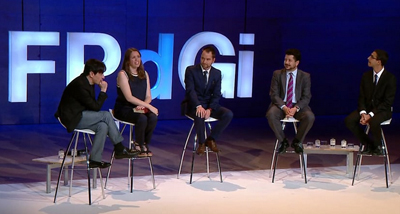 A round table discussion involving Samuel Sánchez, last year’s winner of the Princess of Girona Foundation (FPdGi) Award for Scientific Research, and other former winners was filmed at the recent FPdGi 2016 awards ceremony in Girona.