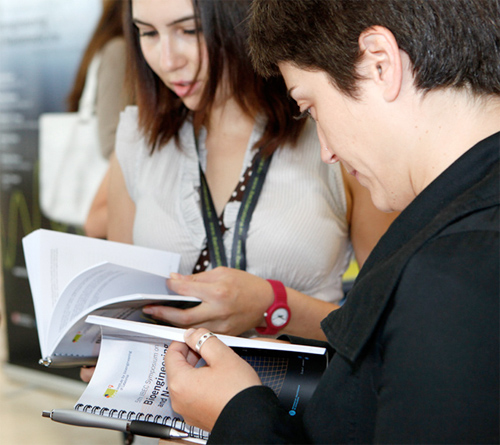
Advanced Summer School in full flow
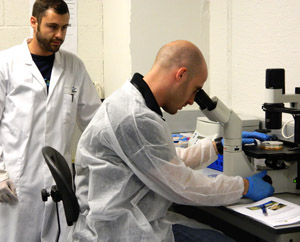
18 young researchers from all over Europe have been learning new skills yesterday and today in the lab sessions part of the second “Interrogations at the Biointerface” Advanced Summer School, hosted by IBEC.
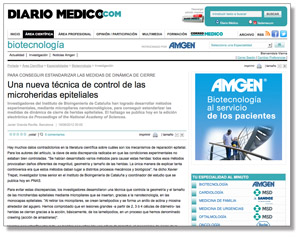
The Integrative Cell and Tissue Dynamics group’s recent paper published in PNAS was covered in Diario Medico last week. In the article, group leader Xavier Trepat explains their new experimental … Read more
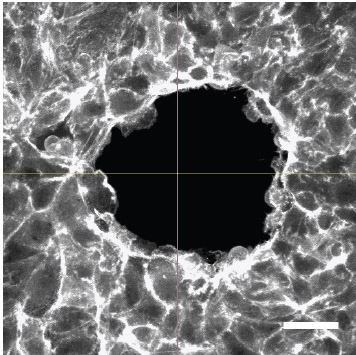
Epithelial tissues line cavities and the surfaces of structures throughout the body, and also form many glands. During development, injury and in various disease conditions, gaps appear in the epidermis, which have to be quickly filled in.The timely closure of the gaps that occur in these cell layers has been studied in great detail, and two possible mechanisms have been suggested; the closure of cells like the strings of a purse over a gap, and the extension of cellular protrusions by the cells surrounding the gap, which will eventually seal it. Different molecular players have been found to be key components of these mechanisms.
Last week Biomedical signal processing and interpretation group leader Raimon Jané was an invited speaker at a special institutional joint session of the CIBER-BBN (Centro de Investigación Biomédica en Red en Bioingeniería, Biomateriales y Nanomedicina) and SEPAR (Sociedad Española de Neumología y Cirugía Torácica) at SEPAR’s 45th National Meeting in Madrid.
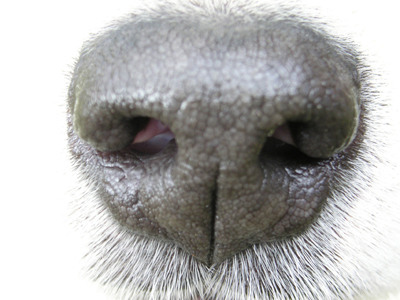
The mammalian sense of smell is an excellent chemical sensing system that far outshines any man-made reproduction, so researchers have long been trying to analyze and recreate the animal olfactory system to develop artificial ‘noses’. Now researchers at IBEC have shed new light on this highly efficient system that could allow better chemical sensing systems with important applications in such critical areas as health, security or the food industry.
This Monday saw IBEC celebrate the milestone of its fifth annual symposium on Bioengineering and Nanomedicine.
Last week saw the start of the three-year European project PLANTOID, of which IBEC’s Nanobioengineering group is a partner, which aims to design and develop robots inspired by plants.Coordinated by the Center for Micro-BioRobotics (CMBR) of the Istituto Italiano di Tecnologia, the project “Innovative Robotic Artefacts Inspired by Plant Roots for Soil Monitoring (PLANTOID)”, which is funded within the European Commission’s prestigious Future and Emerging Technologies Open (FET-Open) scheme, aims to create robots called Plantoids which, combining a new generation of hardware and software technologies, will be able to imitate the behaviour of plant roots.

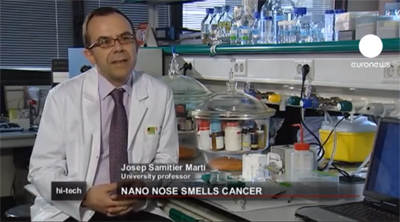
A video about the BOND project and featuring Josep Samitier appeared on Europe’s leading international news channel, Euronews.
Last week IBEC signed two collaboration agreements with the Institut d’Investigació en Ciències de la Salut Germans Trias i Pujol (IGTP) to carry out and promote scientific and translational research.
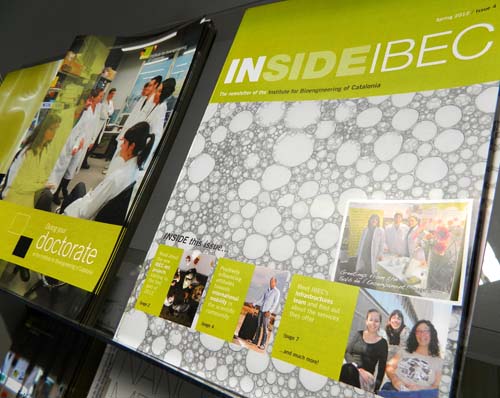
The latest edition of InsideIBEC, the newsletter of IBEC, is available now.