IBEC paper on the cover of Nature Materials

The latest cover of Nature Materials was designed by IBEC PhD student Xavier Serra and shows a real tissue segmented computationally to give the impression of a Gaudinian trencadís.
The latest cover of Nature Materials was designed by IBEC PhD student Xavier Serra and shows a real tissue segmented computationally to give the impression of a Gaudinian trencadís.

The latest cover of the respected chemistry journal Angew Chem features the Nanoprobes and Nanoswitches group’s paper, released online last month, that describes a strategy to quickly and reversibly impair the function of specific proteins using light-regulated inhibitory peptides. As well as being chosen for the cover, their paper was among the 5% to be included in the ‘Very Important Paper’ section of the journal, and has also been extensively publicised in the press both here and abroad.

On Monday IBEC had a visit from Dr. Toni Andreu, the Director of the Instituto de Salud Carlos III (ISCIII), the body which coordinates the Fund for Health of Spain (FIS) for the Spanish Ministry of Economy and Knowledge.

IBEC’s Robotics group leader Alícia Casals represented Catalonia’s scientific community when she and two doctors, a psychiatrist and a biomedical researcher read out a poem at the Concert per la Llibertat at Camp Nou on 29th June.
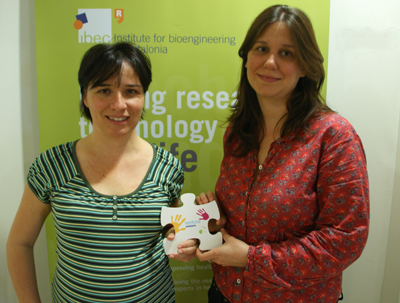
On Monday, at a ceremony in Sabadell, IBEC received its funding award for an outreach project from the Fundació Antigues Caixes Catalanes (formerly Unnim Caixa) of the BBVA.
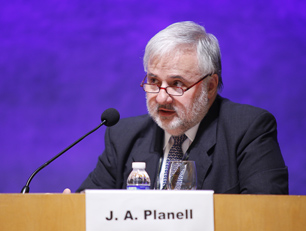
IBEC’s former director Josep A. Planell is the first scientist from Spain to be awarded the prestigious George Winter prize of the European Society for Biomaterials.
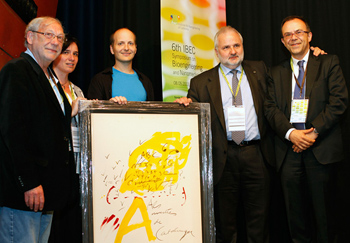 Wednesday’s IBEC Symposium on Bioengineering and Nanomedicine welcomed 230 participants, almost 40 of them coming from outside IBEC from places as far afield as Belgium and Colombia.
At yesterday’s Board of Trustees meeting, Josep Samitier was appointed as the new Director of IBEC.

There’s just over a week to go until IBEC celebrates its sixth annual symposium in bioengineering and nanomedicine.

The picture shows masters student Alejandro Calvo and senior researcher Beatriz Giraldo at this week’s “Recerca en directe” science fair in La Pedrera, where IBEC’s Biomedical Signal Processing and Interpretation group are taking part with an activity that helps participants record and process their own biomedical signals.