HealthTECH World Cancer day 2020
HealthTECH World Cancer day 2020 HealthTECH World Cancer day 2020 es un evento organizado en el marco del Día Mundial del Cáncer donde se darán a conocer las últimas innovaciones … Read more

HealthTECH World Cancer day 2020 HealthTECH World Cancer day 2020 es un evento organizado en el marco del Día Mundial del Cáncer donde se darán a conocer las últimas innovaciones … Read more
HealthTECH World Cancer day 2020 HealthTECH World Cancer day 2020 es un evento organizado en el marco del Día Mundial del Cáncer donde se darán a conocer las últimas innovaciones … Read more
HealthTECH World Cancer day 2020 HealthTECH World Cancer day 2020 es un evento organizado en el marco del Día Mundial del Cáncer donde se darán a conocer las últimas innovaciones … Read more
HealthTECH World Cancer day 2020 HealthTECH World Cancer day 2020 es un evento organizado en el marco del Día Mundial del Cáncer donde se darán a conocer las últimas innovaciones … Read more
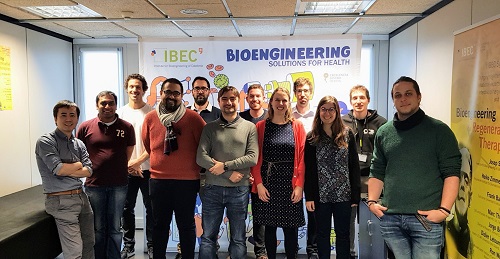
 A group of researchers from the Institute for Bioengineering of Catalonia (IBEC) leads the European project BLOC, an initiative led by researchers Javier Ramón and Irene Marco that seeks to evaluate the response to different drugs in metabolic diseases using organ-in-a- chip by using nuclear magnetic resonance (NMR). For this, the consortium will have a budget of almost 3 million euros, financed by the Horizon 2020 FET Open program.
 Application Deadline: 31/01/2020
Ref: EAA-JS
We are looking for an Executive and Administrative Assistant who has extensive experience to provide executive support to the Director of the Institute. The Director of IBEC carries out multidisciplinary activities, both at the level of research and management of the Institute. It has an international agenda, relating to other Research Centers, Universities, Industry, Hospitals and Governing Bodies, both nationally and internationally. He leads different committees inside and outside IBEC. He has an intense travel schedule, participating as a speaker and as a member of several scientific assessment committees

Application Deadline: 31/01/2020
Ref: SR-SS
The nanodevices group at the Institute for Bioengineering of Catalonia (IBEC) is looking for a Senior Researcher to supervise and carry out research activities in the nano-bio- projects of the Group. The contract will be within the framework of nanobioteam, whose objective is the development of nano- micro- and milli scaled robots for biomedical applications.


Application Deadline: 31/01/2020
Ref:PD-JR
The Biosensors for Bioengineering group led by Dr. Javier Ramón at the Institute for Bioengineering of Catalonia (IBEC) is looking for a Posdoctoral Researcher in order to work in a project of collaboration with NovoNordisk company. This position will be funded by NovoNordisk.


Application Deadline: 31/01/2020
Ref: LT-EM
The Biomimetics Systems for Cell Engineering< group at the Institute for Bioengineering of Catalonia (IBEC) is looking for a Laboratory technician to support technically PhDs and Post-docs in their corresponding projects.
The contract will be within the framework of the INDUCT project, whose objective is to generate “in vitro” intestinal models to study the influence of the intestinal subepithelial myofibroblasts on the intestinal epithelial migration.