DONATE

Range selectivity, a new concept that could lead to more efficient nanoparticle drug delivery 

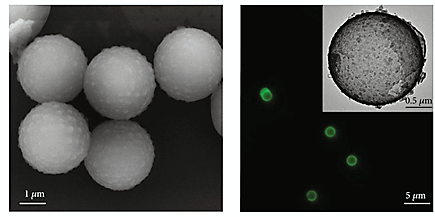
In a new study published in the scientific journal Nature Communications, researchers describe a new concept called “range selectivity”, explaining why biomimetic nanoparticles only bind to receptors when their density is within a precise range.

This finding could pave the way for the development of highly targeted therapies against a number of diseases.

IBEC alumni Riccardo Levato, awarded with an ERC starting grant

Since its foundation in 2006, IBEC has been growing and consolidating as a leading research center. This has only been possible thanks to the work, talent, commitment and motivation of each and every one of the people who are and have been part of IBEC’s big family.

Now, Riccardo Levato, former researcher at IBEC, has been awarded with an ERC starting grant at UMC Utrecht to develop his project named “VOLUME-BIO”.  

IBEC Master Programme fellowships 2020- 4th Edition


IBEC has launched its Master Programme to encourage students to begin a research career in our multidisciplinary research institute. The fellows will carry out research in one of IBEC’s research groups in Barcelona.

The IBEC Master Programme offers 4 fellowships with a monthly stipend of 450€ gross from January to June 2021 for fellows to perform their master thesis at IBEC. The minimum hours to be dedicated are 20h/week.

Postdoc position in NeuroRobotics at the SPECS-lab Research Group


Application Deadline: 30/11/2020
Ref: PD-PV

The Synthetic, Perceptive, Emotive and Cognitive Systems (SPECS) group at the Institute for Bioengineering of Catalonia (IBEC) is offering a Postdoctoral position in NeuroRobotics. The successful candidate will lead SPECS’ NeuroRobotics lab and drive the research on Cognitive Architectures in the context of the Distributed Adaptive Control theory of mind and brain that SPECS-lab has been elaborating over many years [1, 2, 3, 4].
We are seeking a candidate to advance the DAC Architecture towards a whole brain implementation, which maps this cognitive architecture to the main structures of the mammalian brain. We will test these models on robots both targeting rodents level tasks such as foraging and navigation but also, we want to look at human level tasks such as social interaction and motor rehabilitation. The candidate will work directly with the director of SPECS-lab, ICREA Professor Dr. Paul Verschure.

1. Verschure, Paul FMJ. “Synthetic consciousness: the distributed adaptive control perspective.” Philosophical Transactions of the Royal Society B: Biological Sciences 371, no. 1701 (2016): 20150448.
2. Verschure, PFMJ, Pennartz, CM, & Pezzulo, G. (2014). The why, what, where, when and how of goal-directed choice: neuronal and computational principles. Phil. Trans. R. Soc. B, 369(1655), 20130483.
3. Verschure, P. F. (2012). Distributed adaptive control: a theory of the mind, brain, body nexus. Biologically Inspired Cognitive Architectures, 1, 55-72.
4. Verschure, PFMJ T Voegtlin T, RJ Douglas (2003) – Environmentally mediated synergy between perception and behaviour in mobile robots Nature – pdfs.semanticscholar.org

Laboratory Technician at the Research Group Biosensors for Bioengineering


Application Deadline: 15/10/2020
Ref: LTII-IM

The The Biosensors for Bioengineering Group group at the Institute for Bioengineering of Catalonia (IBEC) is looking for a laboratory technician to work on the development of radiofrequency coils for magnetic resonance to study metabolism on tissue engineered organ-on-a-chip systems.

The contract will be within the framework of the EU FET Open project “Benchtop NMR spectrometer for lab-on-a-chip” (https://blocproject.eu), whose objective is the development of non-invasive assays based on hyperpolarized magnetic resonance (MR) to study real-time metabolism on tissue engineered organ-on-a-chip systems.