Junior Project Manager at the Plataforma ISCIII Biobancos y Biomodelos (Ref.: PM2-NM)

Ref: PM2-NM // Deadline: 18/03/2024

Ref: PM2-NM // Deadline: 18/03/2024

Ref: PM1 // Deadline: 18/03/2023
Ref: PPCC-MnkImmunOnco/ Deadline: 08/05/2023

With these words Josep Samitier inaugurated last week the tribute event to Josep A. Planell, one of the founders and first director of IBEC, for a whole life dedicated to … Read more
Mastering communication between synthetic or hybrid materials with tissues is one of the grand challenges of contemporary biomedical systems that our society demands. We want to uncover design rules to … Read more

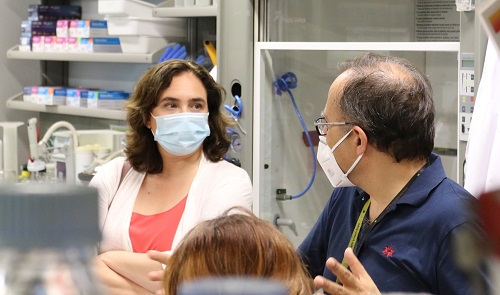
 The Mayor of Barcelona, Ada Colau, visited IBEC facilities last Friday to learn, by our Director and a group of researchers, how bioengineering can help find solutions to health problems such as COVID19, cancer, or degenerative diseases.
When in early 2020, more than 200 scientists gathered in La Pedrera in Barcelona to discuss the present and future of bioengineering, no one imagined that the world would experience the first pandemic of the 21st century and that science would take on more importance than ever.
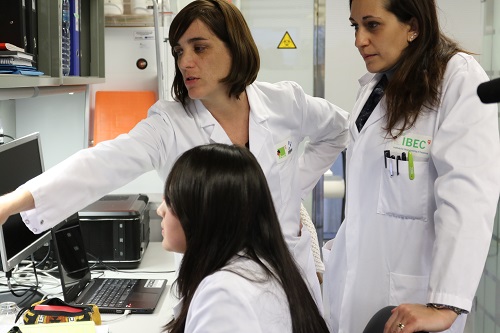
 IBEC researchers led by ICREA Research Professor Núria Montserrat, together with international collaborators, have identified a drug capable of blocking the effects of the SARS-Co-V2 virus, the origin of the Coronavirus 2019 disease.
The treatment, which can be tested on two hundred Covid-19 patients as of today, has proven effective in mini-kidneys generated from human stem cells. Using hese organoids generated by bioengineering techniques, it has been deciphered how SARS-Co-V2 interacts and infects human kidney cells.

 IBEC appears on the catalan news on TV3, where they summarise the various Catalan initiatives to fight against Covid-19.
Researchers at IBEC led by the ICREA Professor Núria Montserrat contribute to the EU project BRAVƎ, an initiative for cardiac regeneration that combines cell therapy and bioengineering to design a biological device capable of recovering cardiac functionality in people with coronary heart disease.